
Know someone who should see this? And Canada is taxing you back. What Canada taxes are American exports, the things American workers grow and build. Today the list is steel and almost nothing else. September's includes groceries. Tariff lines by product category. The rates: Every line Canada taxes today is 25%. September adds a 50% tier and puts hundreds of American steel and aluminum lines in it. Tariff lines by rate, from September 8. Look it up: Every American product on Canada's list, all of them. Filter it, or search for something specific. These numbers are public. Almost nobody has seen them. If you know someone who should, send them the link.
Method: Every number on this page is measured, with one exception. Nothing here is a forecast or a projection. The exception is What tariffs cost your household, above, which needs an assumption no dataset can supply. It says so at the top of the section and carries a label wherever it appears. Elsewhere, when a question could only be answered by assuming something, we say so and leave the number out. Six public datasets, all free, all citable: Duty actually collected on Canadian goods, and the value it was charged on — U.S. Census Bureau. U.S. exports to Canada by state and commodity. U.S. exports to Canada by state and industry. U.S. energy imports from Canada by state. Household count — U.S. Census Bureau, ACS 1-year 2024. Canada's counter-tariff list — Department of Finance Canada.
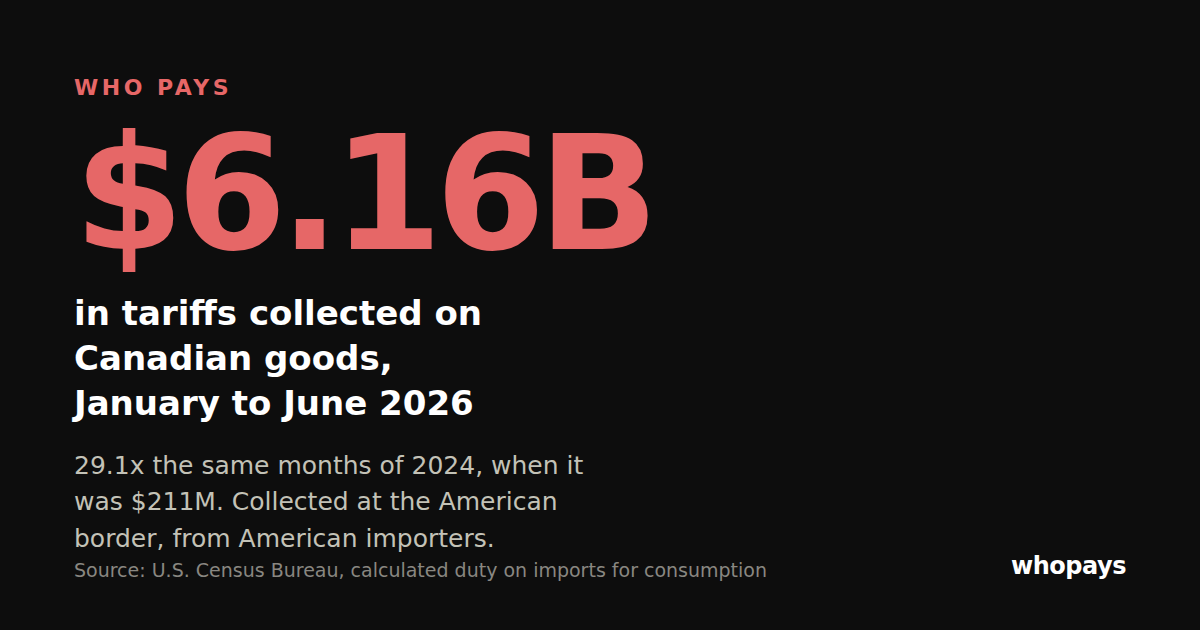
Two tariffs, two payers. Canada's counter-tariffs are paid by Canadian importers and show up in Canadian prices. What they hit on this side is American exporters, the people who make what is on the list. Washington's tariffs on Canadian goods are paid at the American border by American importers, and that is the duty counted in What you have already paid. Two different taxes with two different payers. Do not add them together.
What this page does not tell you, because the data cannot: How much of the duty on Canadian goods reaches a shelf price. That is pass-through, and it is a margin decision made firm by firm. The Canada figures above assume nothing about it. They are duty collected at the border. The one modelled number on this page does state a pass-through rate, but for tariffs on all U.S. imports rather than Canada's alone. See below. What a tariff will do to any future price, at the pump or anywhere else. How many jobs are at risk. Turning export dollars into a job count needs an attribution model we do not have. What share of any industry's exports is tariffed. The tariff list is classified by HS and the industry data by NAICS; joining them takes a concordance we do not have, and guessing one would manufacture a number. Counting tariff lines tells you how wide the list is, not how much money is on it. One line can carry a billion dollars of trade or almost none. That is why the dollar figures come from trade data instead of from the list.
Source: Hacker News · Summarized by HeadlinesBriefing