
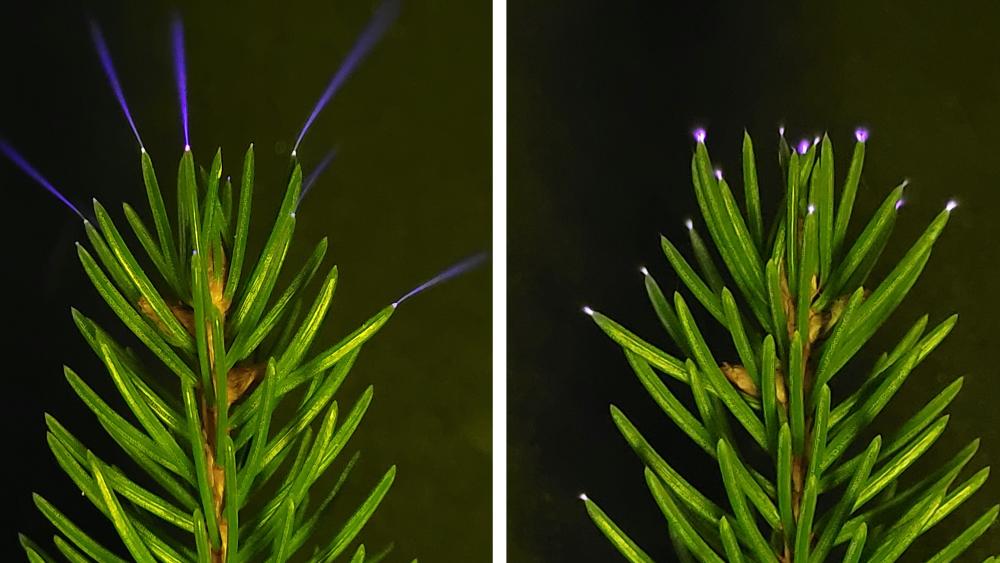
Penn State researchers made history by capturing the first direct evidence of corona discharges on tree leaves in nature. Using a custom-built Corona Observing Telescope System, the team documented glowing electrical pulses at leaf tips during thunderstorms in North Carolina. This phenomenon, theorized for decades, occurs when storm clouds generate electric fields that ionize leaf tips, creating UV light visible only to instruments. The discovery bridges a 70-year gap between theory and observation, with potential implications for atmospheric chemistry and forest health. William Brune, lead researcher, emphasized that this validates decades of speculation about atmospheric electricity interactions with vegetation.
The team’s Corona Observing Telescope System combines a UV camera, atmospheric electricity sensors, and geolocation to track discharges. During a storm off Interstate 95, the system recorded 859 events on a sweetgum tree and 93 on a loblolly pine. Corona discharges form when negative charges in clouds attract positive ground charges, which travel up trees to leaf tips. This process breaks down water vapor into hydroxyl—a key atmospheric oxidizer that cleans pollutants like methane and volatile organic compounds. Prior lab experiments showed UV from corona correlates with hydroxyl production, but field validation was lacking. The technology’s precision allowed researchers to correlate observable glows with chemical reactions, revealing corona’s role in air purification.
While the phenomenon is nearly invisible to the human eye, its ecological impact remains uncertain. Researchers are now collaborating with tree ecologists to study whether trees benefit or suffer from corona exposure. Potential effects include subtle leaf damage or enhanced atmospheric cleansing. The findings, published in *Geophysical Research Letters*, highlight how natural processes can contribute to environmental sustainability. As hydroxyl production scales with storm frequency, this discovery could refine models of how forests interact with climate systems. Brune noted that future work will focus on quantifying these interactions, but the immediate takeaway is that nature’s electrical activity holds untapped scientific value.
Source: Hacker News · Summarized by HeadlinesBriefing