
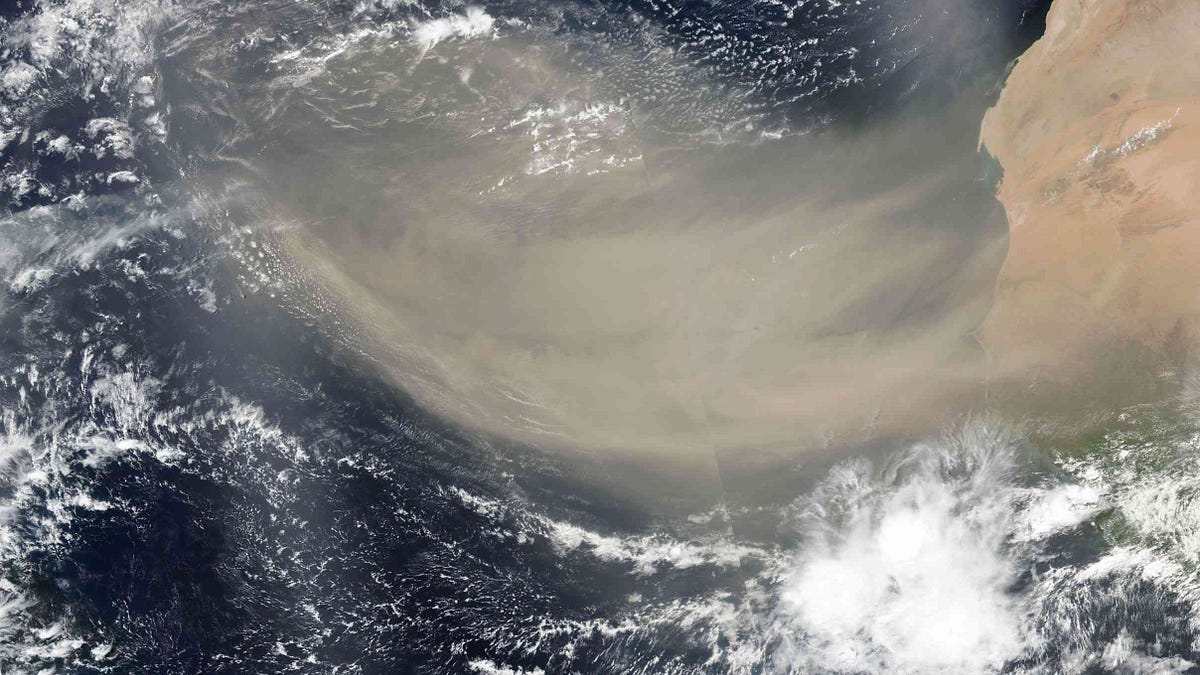
Never in a million years would the craziest of the mad geoengineers dream of adding a fraction of the iron the Sahara dumps on the North Atlantic every day. Nature puts minerals into the ocean constantly — volcanoes, wildfires, whales, dust storms, icebergs — and satellites plus research ships have documented the cause-and-effect for over twenty years. Most open ocean is a desert; give phytoplankton their missing iron, nitrogen, or phosphorus and they multiply, sucking carbon from the air. The effect fades within weeks when the nutrient source stops.
A 2019 cruise to the Tonga-Kermadec vents (published in *Science* 2023) found a single vent string feeds a patch the size of Germany, driving nitrogen-fixer growth 2-8x faster and pulling 2-3x more carbon into the deep. Similar iron-fed blooms trace to ridges off Africa, Antarctica, and across the Pacific. Dust is the biggest natural fertilizer: 2001 Gobi dust doubled living carbon in two weeks; 2012 Arabian Sea dust caused a fivefold chlorophyll jump; a 2024 study shows dust sustains ~1/3 of Southern Ocean plant growth yearly (~2/3 during the last ice age).
Volcanic ash gives sharp proof: Kasatochi 2008 sparked a massive Gulf of Alaska bloom; Eyjafjallajökull 2010 ash fed North Atlantic plankton; Kīlauea 2018 ash triggered a bloom 5x Taiwan size. Wildfires add potent, easily dissolved iron: 2019–2020 Australian fires ignited a Southern Ocean bloom lasting 9 months; Siberian, Canadian, and Californian fires show similar fingerprints. Remote Southern Ocean islands — Kerguelen, Crozet, South Georgia — serve as intensively studied natural laboratories.
Source: Hacker News · Summarized by HeadlinesBriefing