
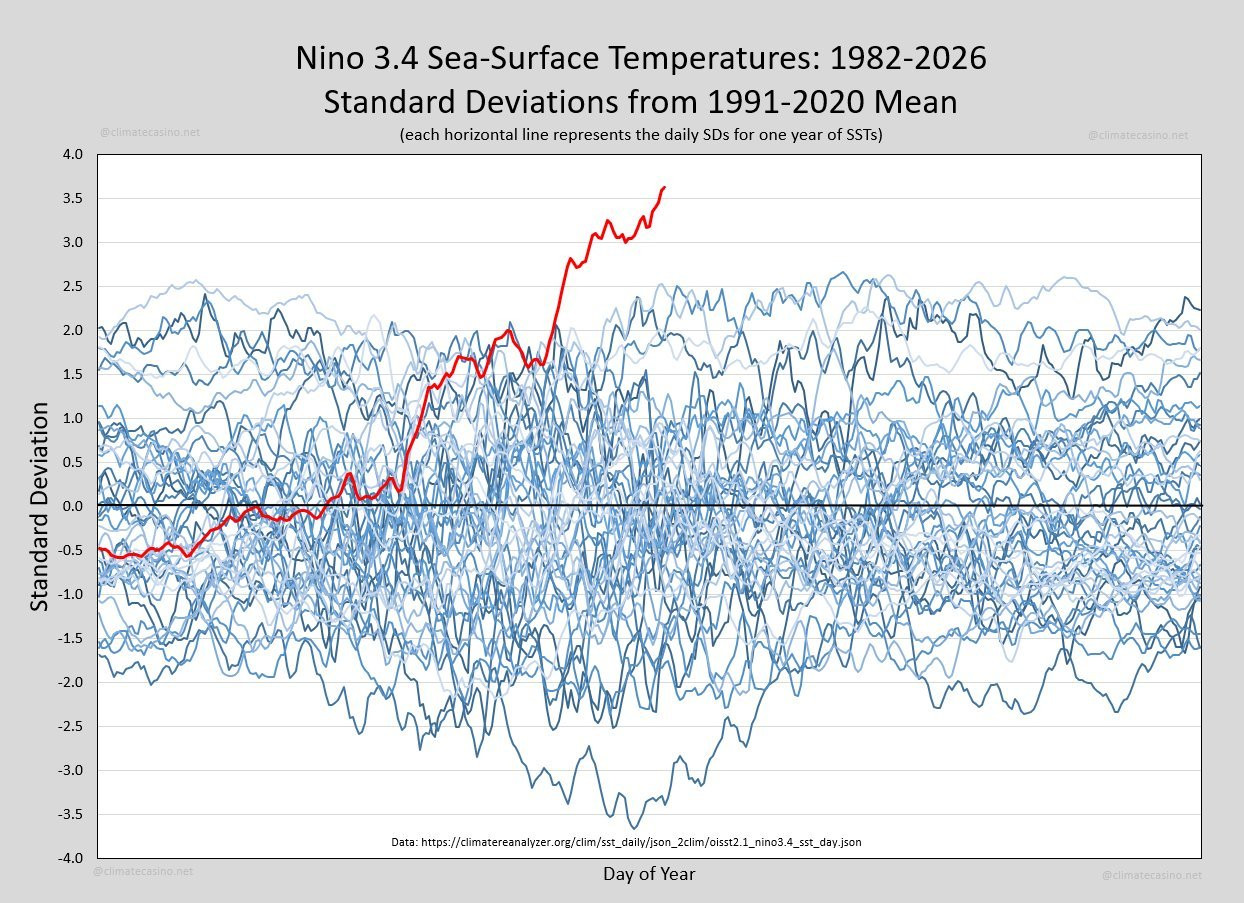
Every so often the Earth produces a signal impossible to ignore. This graph shows sea-surface temperatures in the Niño 3.4 region of the equatorial Pacific. Each blue line represents a year since 1982; the red line is this year. It hasn't just set a record—it has departed entirely from previous observations. This is not a model or forecast but direct observations from satellites, ships, and buoys.
The Niño 3.4 region drives global atmospheric circulation through El Niño–Southern Oscillation. During El Niño, warm water alters wind and rainfall globally: Australia faces drought and bushfire, South America flooding, Asia drought. Human activities have raised CO₂ by over fifty per cent since the Industrial Revolution; ninety per cent of excess heat is absorbed by oceans. The tropical Pacific now oscillates around a warmer baseline, amplifying extremes—heavier rainfall, deeper droughts, stronger storms.
Australia has already experienced this: Black Summer bushfires, coral bleaching on the Great Barrier Reef, marine heatwaves off Western Australia. Oceans regulate climate, transport heat, and sustain ecosystems. When temperatures exceed historical ranges, coral bleaches, fish migrate, kelp collapses, oxygen declines. These changes risk cascading tipping points: the Atlantic Meridional Overturning Circulation, Greenland's ice sheet, West Antarctica, Arctic sea ice, and the Amazon.
Ultimately, this graph shows Earth moving beyond conditions in which modern civilisation developed. The question is whether we act before changes become unmanageable.
Source: Hacker News · Summarized by HeadlinesBriefing