
Comparisons of Claude Code and Cursor often contradict each other because token costs depend on the task, codebase, and how the human drives the agent, not the tool itself. Feature tables typically highlight tab autocomplete versus terminal agents or multi-model versus Claude-only capabilities, yet these rarely help teams decide. One benchmark claims Claude Code used 33,000 tokens while Cursor used 188,000 on the same work; another reports the exact reverse.
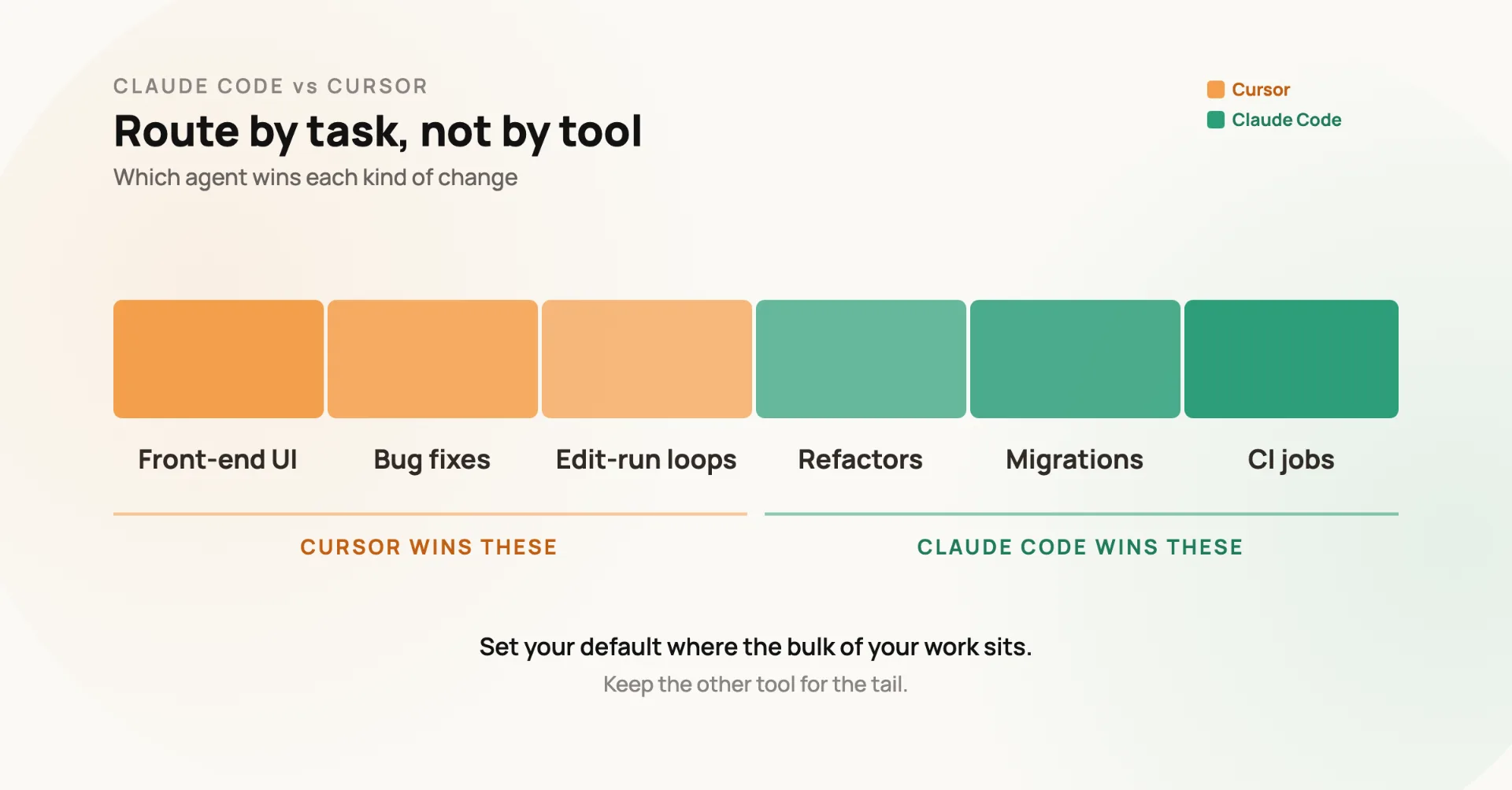
Both sets of numbers are real, revealing that coding task costs are properties of the specific work, not the model. The field test methodology measures cost per successful outcome rather than cost per task, which changes the decision criteria. Claude Code is agent-first and terminal-native, designed for autonomous tasks like multi-file refactors and migrations that run without human-in-the-loop.
Cursor is IDE-first, built as a VS Code fork for interactive loops where the human drives and the agent accelerates, supporting tab autocomplete and visual diff reviews. The architectural difference means one tool assumes the human briefs and the agent executes, while the other assumes the human drives and the agent assists. Standard comparisons mislead by measuring cost per task instead of cost per shipped change, ignoring that cheap tasks requiring rework are not truly cheap.
The right approach is running a small field test on actual work to measure the metrics that matter for the team's specific workflow.
Source: Towards Data Science · Summarized by HeadlinesBriefing