
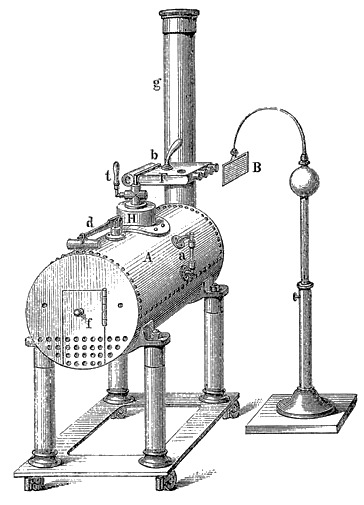
In September 1840, engine driver Patterson felt a tingling spark while reaching into a leaking steam cloud at Cramlingham Colliery. He and colleagues reproduced the phenomenon, prompting solicitor‑engineer William Armstrong to investigate. Correspondence with Michael Faraday confirmed that friction between fluid droplets and metal generated static electricity, a process later named the Armstrong effect.
Armstrong built an “evaporating apparatus” that used steam or compressed air to launch droplets through a friction nozzle, producing sparks up to 12 inches long. He scaled the concept into a full‑size hydroelectric machine with 46 steam jets, displayed at London’s Royal Polytechnic Institution and exported to the United States. The devices featured no moving parts, generated deafening noise, and could discharge 22‑inch sparks capable of killing a large man.
Although primarily a spectacle, the Armstrong effect found modern utility in paint‑spray technology, where charged droplets improve adhesion and reduce material use. The phenomenon also caused industrial hazards, such as 1969 oil‑tanker explosions during high‑pressure water cleaning. Armstrong’s work earned him a Royal Society fellowship in 1846 and cemented his reputation as a pioneer of electrostatic engineering.
Source: Hacker News · Summarized by HeadlinesBriefing