
Retailers dropping limited-edition sneakers at noon now watch inventory vanish in seconds, snapped up by automated bots rather than real customers. Traditional defenses like CAPTCHA, IP rate limits, and phone verification have become ineffective because they rely on proxies that adversaries can acquire cheaply in bulk. These methods authenticate individual sessions but cannot prove a user is unique across the entire internet population.
Authentication systems solve one-to-one matching problems, not one-to-many uniqueness at scale. Face ID on a phone compares a face against a single stored template, achieving reliable results with modest error rates. However, verifying that a buyer differs from every past purchaser requires checking against potentially billions of templates, making false positives inevitable with standard biometrics. The per-comparison error rate must improve to one in a hundred billion or better for internet-scale uniqueness.
World addresses this through iris pattern recognition, which offers sufficient entropy for billion-scale comparisons. Their Orb device captures multispectral images while running neural networks locally to verify liveness, then deletes original images. The derived biometric data gets split across multiple legal jurisdictions using anonymized multi-party computation, allowing duplicate detection without exposing usable biometric information to any single party.
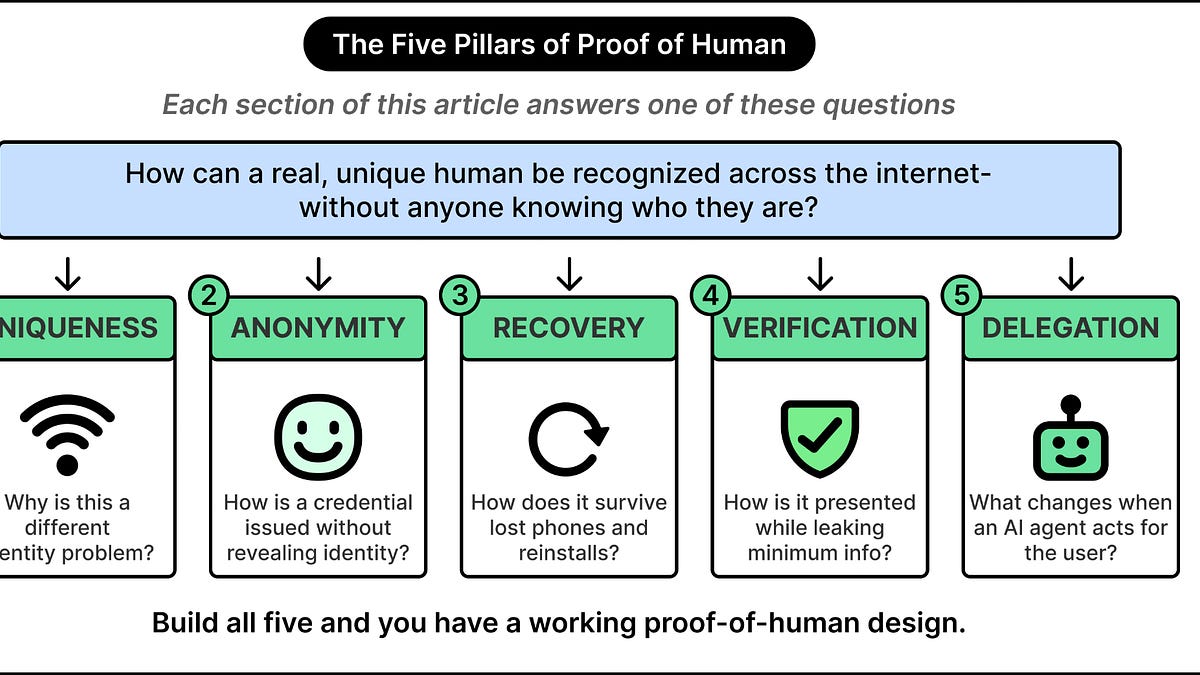
The system also handles recovery when users lose phones or reinstall apps, and considers delegation scenarios where AI agents act on behalf of humans. This represents fundamentally new infrastructure for proving human uniqueness across the internet, distinct from traditional authentication approaches.
Source: ByteByteGo · Summarized by HeadlinesBriefing