
Designed and assembled in America, Matic is the world’s first robot built to understand you. Its Matic Cues let you interact by pointing and speaking, e.g., “Hey Matic, clean this.” It understands 70+ languages, works without an app, and is usable by kids and grandparents. The company offers a 6‑month money‑back guarantee.
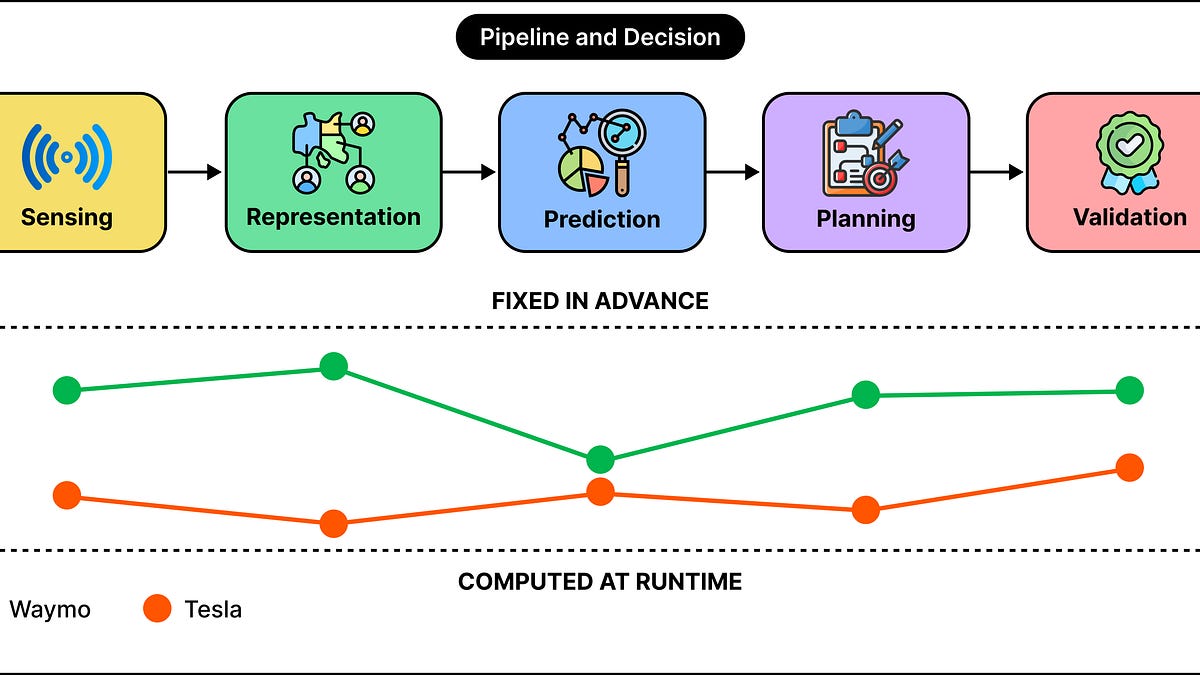
Self‑driving cars must detect what is nearby, classify each object, estimate its motion, select a path, and issue steering or braking within a second. While processing speed is largely solved, handling unpredictable traffic remains an open problem because real‑world scenarios exceed any pre‑determined set.
Waymo reports 220.6 million rider‑only miles through March 2026 across five metros, while Tesla drives over 30 billion miles a year with over three million vehicles in the U.S. and 1.28 million Full‑Self‑Driving subscriptions in Q1 2026; its limited driverless service runs in Austin, Dallas, Houston, and the Bay Area with a safety driver.
Waymo’s sixth‑gen system uses 13 cameras, four lidar units, six radar units and audio sensors for 500 m coverage. Tesla relies on pure‑vision cameras only, using 48 networks for semantic segmentation, monocular depth and bird’s‑eye mapping, trained on 70,000 GPU hours to output 1,000 tensors per step.
Source: ByteByteGo · Summarized by HeadlinesBriefing