
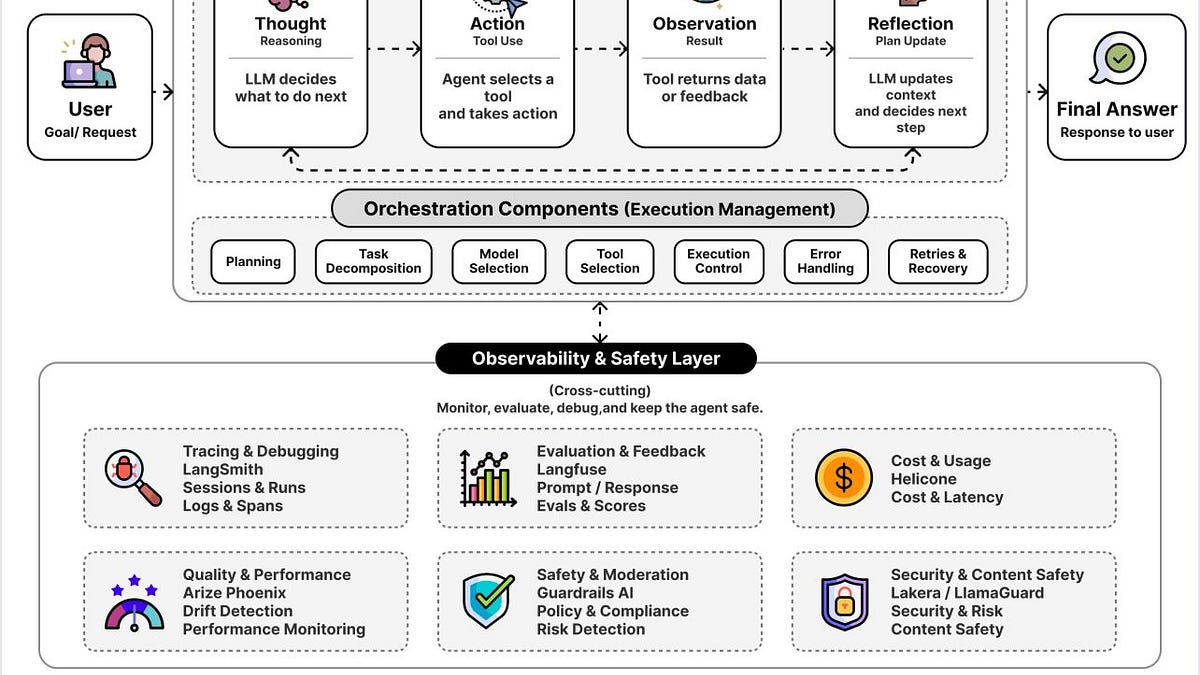
ByteByteGo breaks down the AI agent stack, showing why agents are more than clever prompts. At the center sits the Agent Runtime, a ReAct loop where an LLM decides actions, selects tools, observes outcomes, and iterates until a goal is met. Surrounding this core are three functional layers that enable reasoning, interaction, and memory. Each layer contributes specific capabilities for production workloads.
The Model Layer supplies the brain, hosting the underlying LLMs that perform reasoning. The Tool Layer acts as the hands, exposing search APIs, code execution, and data access so agents can act on real‑world resources. The Memory Layer provides a notebook‑style store, mixing short‑term working memory with long‑term semantic and transactional memory for state tracking and ensures consistent context across sessions.
Wrapping the stack is the Observability & Safety Layer, which keeps agents debuggable, cost‑aware, and secure in production. ByteByteGo warns that careless authentication, like vibe‑coding auth, poses risks, recommending connection to Descope’s MCP server for identity management. The article invites engineers to consider which stack layer proves hardest to operationalize, emphasizing disciplined safety over raw speed.
Source: ByteByteGo · Summarized by HeadlinesBriefing