
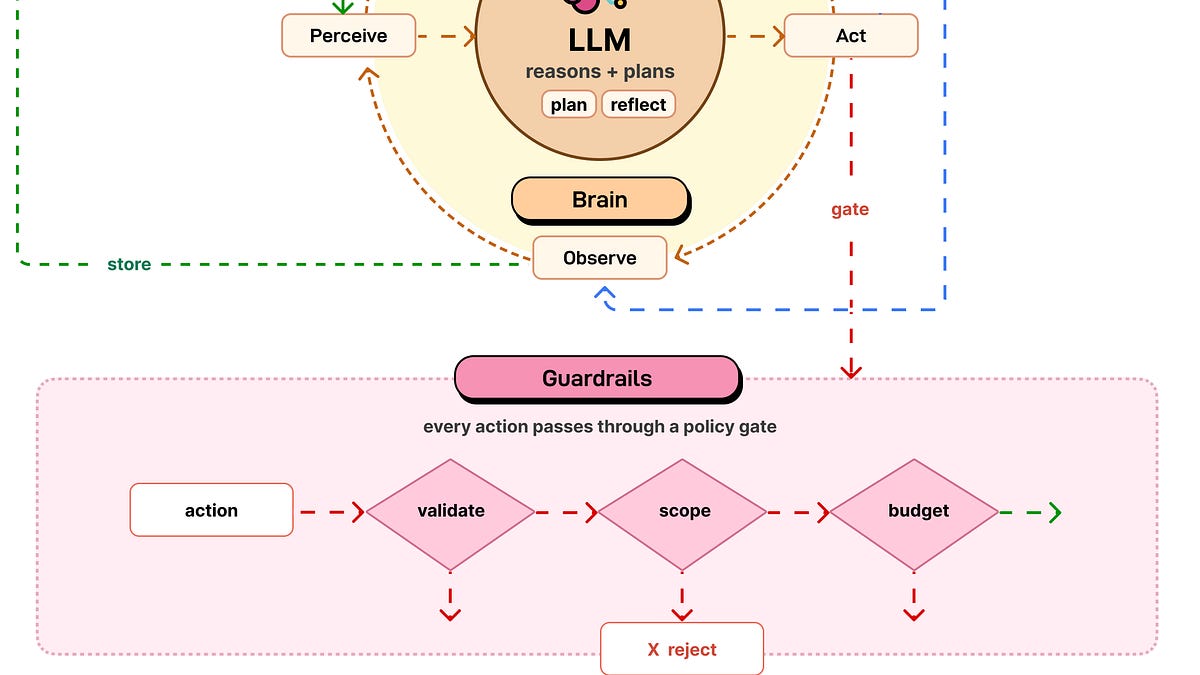
ByteByteGo's latest system design refresher breaks down the anatomy of an AI agent. The core insight: an agent is essentially a while-loop that uses an LLM to select actions, execute them, evaluate results, and repeat until the task completes. This represents a fundamental shift—the model isn't writing text anymore, it's making choices.
The architecture consists of five interconnected components. The brain is the LLM handling reasoning. Planning breaks complex tasks using methods like Chain of Thought or Tree of Thoughts. Tools let agents call functions—web search, code execution, APIs—often via the MCP standard. Memory manages both short-term context windows and long-term vector storage. Guardrails including sandboxing, human checks, and output validation prevent autonomy from spiraling into expensive problems.
The piece also compares API approaches: REST for public APIs and broad compatibility, GraphQL when clients need flexible aggregated views, and gRPC for internal microservices where latency matters. Understanding these architectural patterns helps developers make informed decisions when building agentic systems.
Source: ByteByteGo · Summarized by HeadlinesBriefing