
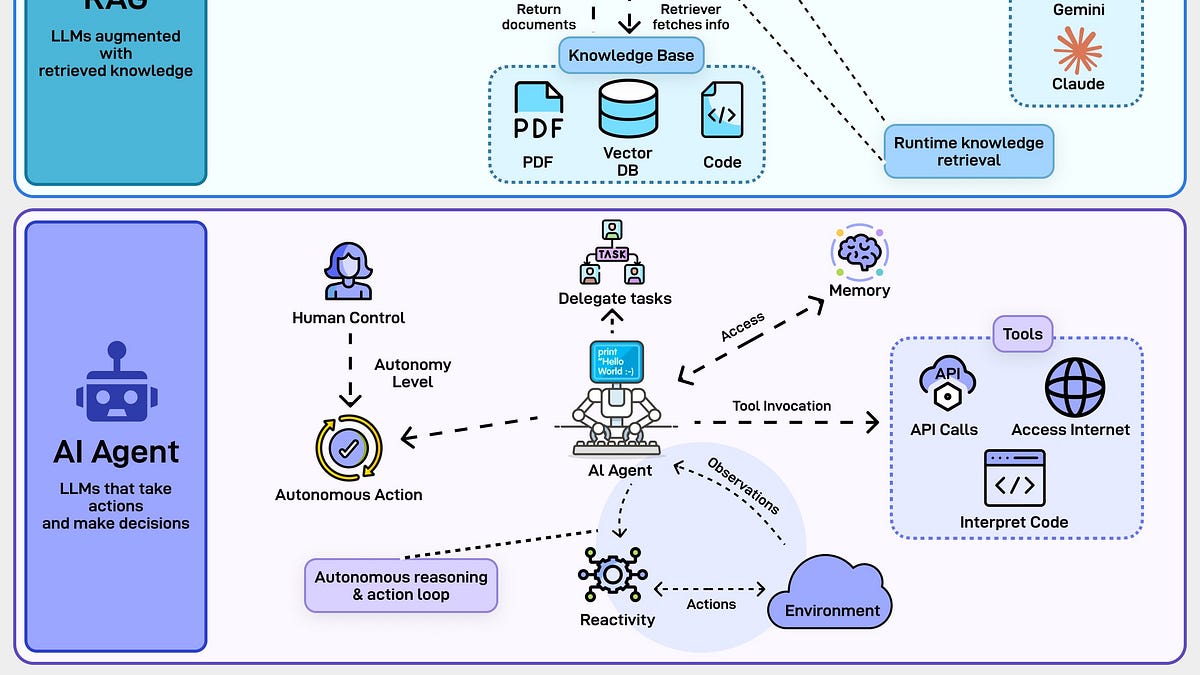
Model Context Protocol (MCP), Retrieval-Augmented Generation (RAG), and AI Agents represent three distinct approaches to enhancing AI capabilities, yet confusion persists about their roles. ByteByteGo Newsletter clarifies these concepts in its latest issue, explaining how each serves different purposes in the AI stack. While MCP standardizes tool access, RAG enriches knowledge, and agents enable autonomous action.
MCP functions as a standard interface between large language models and external systems like databases, file systems, and APIs. Rather than forcing each application to create custom integration code, MCP provides consistent protocols for tool discovery, invocation, and structured result handling. RAG addresses knowledge limitations by retrieving relevant documents at runtime and injecting them into prompts, making it ideal for internal knowledge bases and reducing hallucinations. AI Agents operate at a higher level, capable of observing, reasoning, deciding, acting, and repeating processes. They can call tools, write code, browse the internet, store memory, and operate with varying autonomy levels.
Understanding these distinctions matters because they solve fundamentally different problems. MCP doesn't determine what actions to take but standardizes how tools are exposed. RAG improves answer quality without taking actions. Agents coordinate multiple capabilities to achieve goals. The newsletter also explores how ChatGPT routes prompts through different modes—instant, thinking, auto, and pro—each optimized for specific use cases from simple queries to complex reasoning tasks.
Source: ByteByteGo Newsletter · Summarized by HeadlinesBriefing