
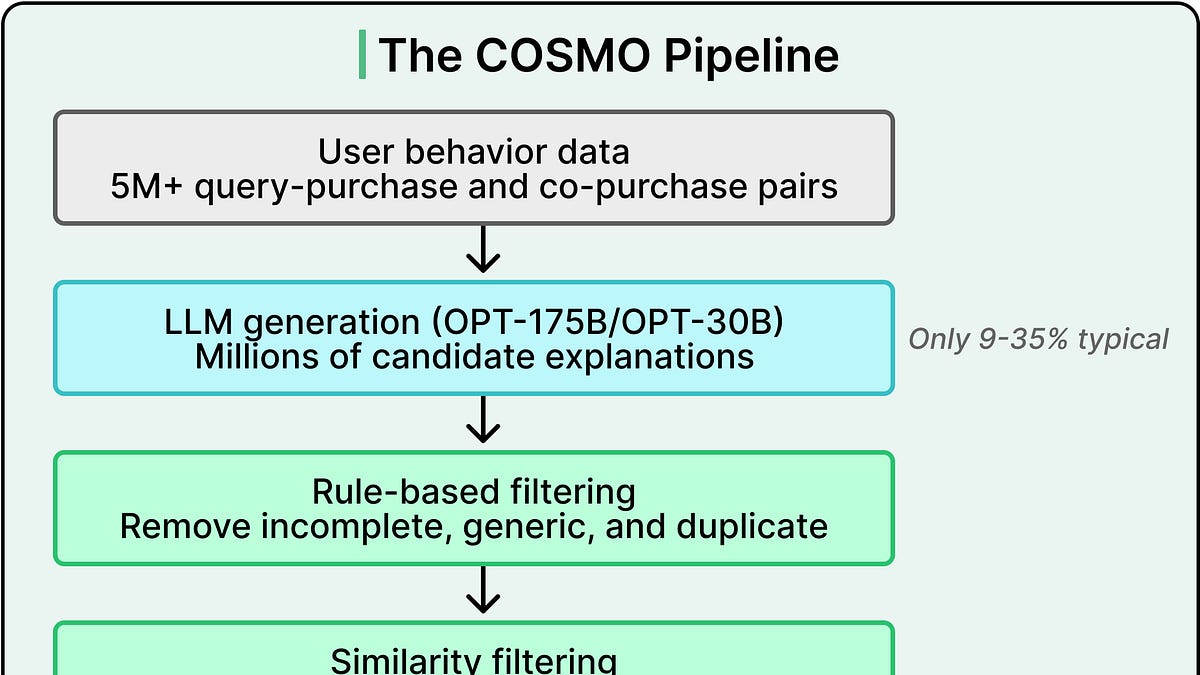
Amazon’s search team built a commonsense knowledge graph called COSMO to bridge the gap between a shopper’s intent and product listings. When a user types “shoes for pregnant women,” the engine must infer that stability matters and surface slip‑resistant shoes, even though the term “pregnant” never appears in the catalog. Traditional recommenders struggle because they rely on direct keyword overlap.
The team fed millions of query‑purchase and co‑purchase pairs into internal LLMs—OPT-175B and OPT‑30B—running on sixteen A100 GPUs to respect data‑privacy constraints. Across 18 categories they collected 1.87 million query‑purchase and 3.14 million co‑purchase examples, then prompted the model to generate numbered explanations. Only about 35 % of query‑driven outputs and 9 % of co‑purchase rationales significantly passed Amazon’s overall quality threshold.
To turn noisy generations into a usable ontology, Amazon applied a four‑stage refinement pipeline: coarse rule‑based filters removed incomplete or duplicate sentences, similarity checks pruned generic phrasing, and a language‑model scorer eliminated low‑entropy candidates. The remaining patterns were collapsed into 15 relation types such as used_for_function, used_in_location, and xWant, giving COSMO a structured commonsense layer that powers more human‑like product recommendations.
Source: ByteByteGo · Summarized by HeadlinesBriefing