
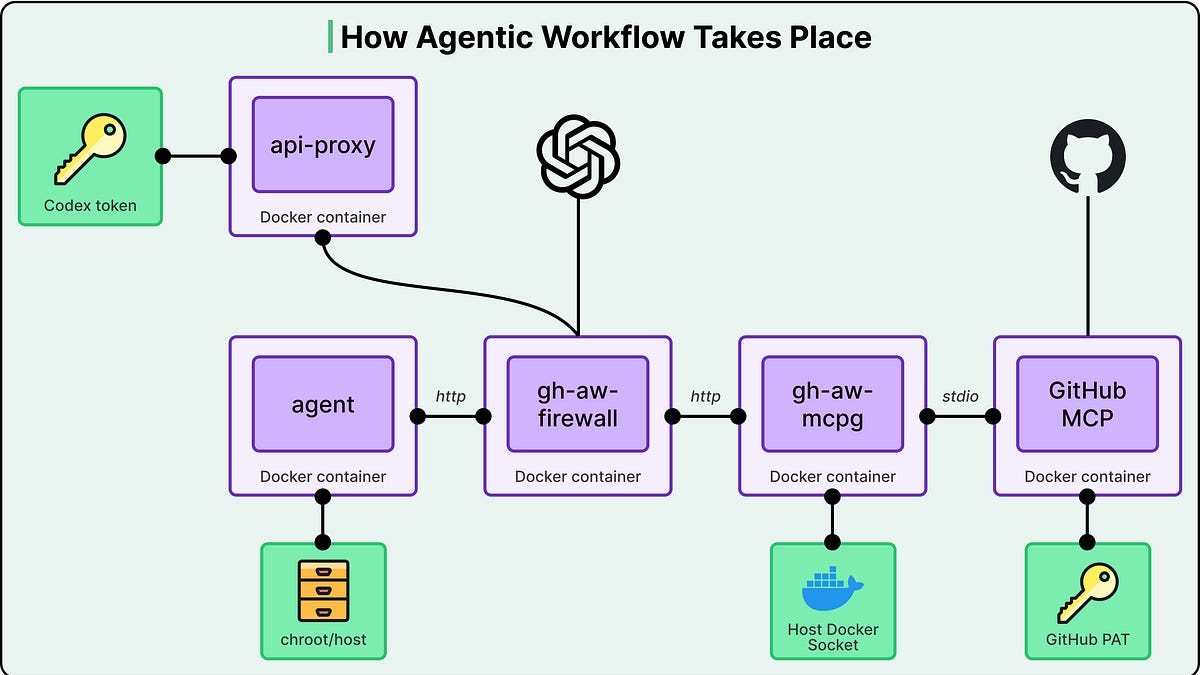
GitHub built an AI agent that can fix documentation, write tests, and refactor code while you sleep. Then they designed their entire security architecture around the assumption that this agent might try to steal your API keys, spam your repository with garbage, and leak your secrets to the internet. This can be considered paranoia, but it's the only responsible way to put a non-deterministic system inside your CI/CD pipeline.
GitHub Agentic Workflows let you plug AI agents into GitHub Actions so they can triage issues, generate pull requests, and handle routine maintenance without human supervision. The appeal is clear, but so is the risk. These agents consume untrusted inputs, make decisions at runtime, and can be manipulated through prompt injection, where carefully crafted text tricks the agent into doing things it wasn't supposed to do. In this article, we will look at how GitHub built a security architecture that assumes the agent is already compromised.
GitHub's threat model for Agentic Workflows is blunt. They assume the agent will try to read and write state that it shouldn't, communicate over unintended channels, and abuse legitimate channels to perform unwanted actions. For example, a prompt-injected agent with access to shell commands can read configuration files, SSH keys, and Linux /proc state to discover credentials. It can scan workflow logs for tokens. Once it has those secrets, it can encode them into a public-facing GitHub object like an issue comment or pull request for an attacker to retrieve later.
Source: ByteByteGo · Summarized by HeadlinesBriefing