
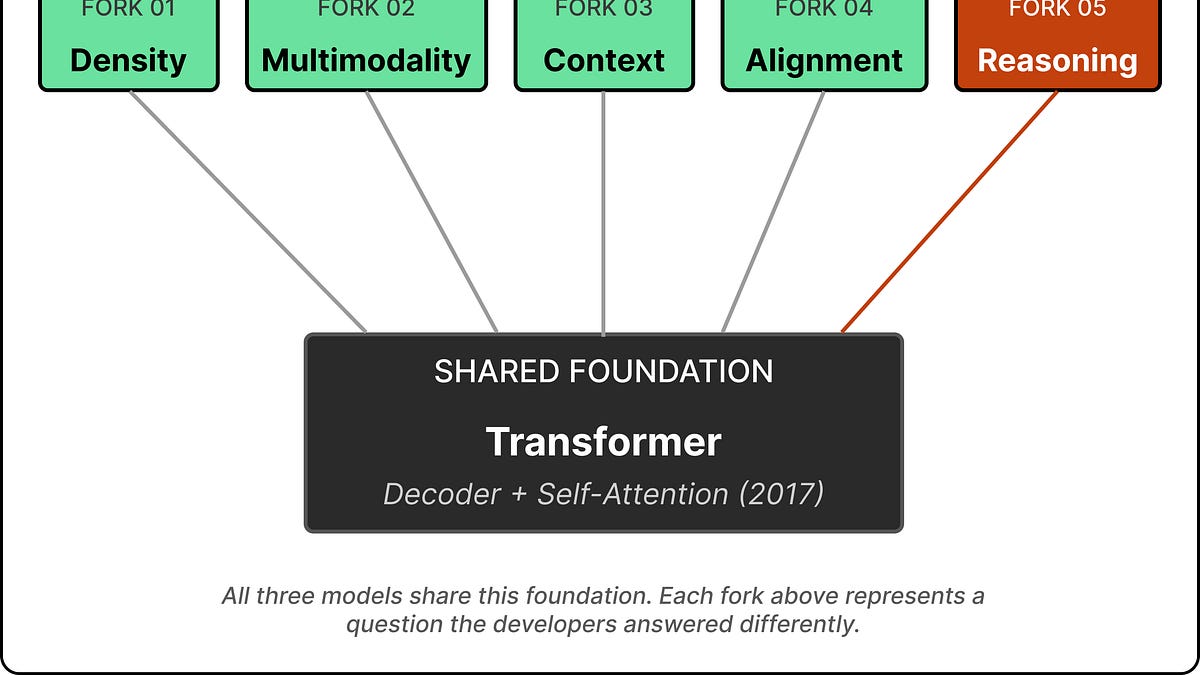
Large language models like ChatGPT, Gemini, and Claude exhibit distinct user-facing behaviors stemming directly from fundamental architectural decisions made during their development. While all share a transformer-based neural network foundation, their scaling strategies and multimodal input handling diverge significantly.
Google's Gemini employs a Mixture of Experts (MoE) architecture, where specialized subnetworks ('experts') process different tokens. This allows for immense total parameter counts while activating only a fraction per query, enhancing cost-efficiency. However, it can lead to response variance as prompts route to different experts. OpenAI's GPT models, while not explicitly confirmed to use MoE for GPT-4, describe a system where routers select between distinct sub-models for efficiency. Dense models, in contrast, activate all parameters per token, offering more predictable behavior but scaling less efficiently to extreme sizes.
Multimodal input processing also reveals architectural forks. Gemini utilizes a native approach, training on text, images, audio, and video simultaneously within the same transformer layers. This enables seamless handling of diverse inputs like long video files. OpenAI transitioned GPT-4o to a unified architecture after earlier models used separate pipelines. Anthropic's Claude, while supporting high-resolution image input, maintains a text-first focus, not natively incorporating audio or video processing in the same way. These choices directly impact how users interact with and rely on the models for different tasks.
Source: ByteByteGo · Summarized by HeadlinesBriefing