
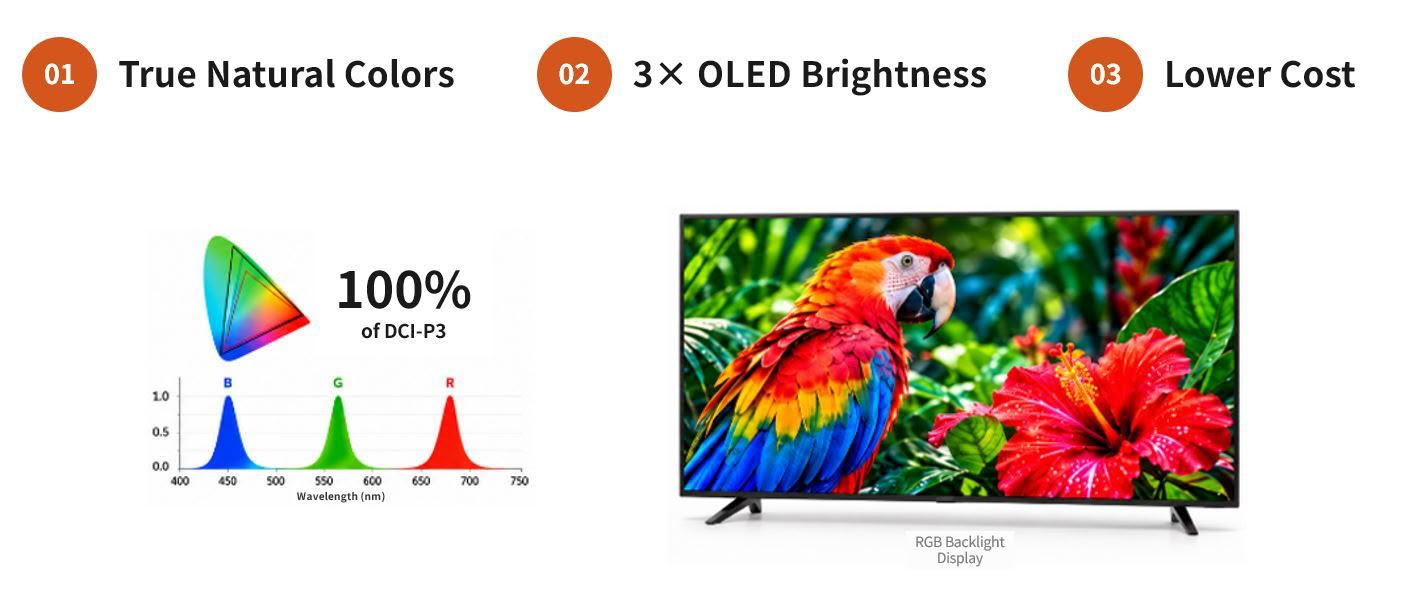
Seoul Semiconductor Co., Ltd. today announced that its 'WICOP Pixel' technology, developed by subsidiary Seoul Viosys, has entered full-scale mass production. The package-free technology arranges RGB chips at an ultra-fine pitch of several tens of micrometers to render tens of thousands of colors. Replacing conventional white-light LCD backlights, the technology achieves 100% of DCI-P3 color gamut, the international film industry standard, while delivering more than three times the brightness of OLED displays.
In the third quarter, the company's display-related revenue rose nearly 20% year-over-year. To meet global capacity needs, Seoul Semiconductor plans to convert existing white backlight capacity to WICOP Pixel production rather than make large new investments, while expanding revenue and profit through a global patent licensing program. The core technology reproduces natural colors and scenes more faithfully than OLED and heightens immersion even in bright settings such as living rooms and public spaces.
It reduces dependence on expensive LCD panels and the company is researching technology to eliminate the color filter, which accounts for about 20% of LCD panel material costs. Its peak brightness of up to 3,000 nits is more than three times that of OLED, delivering sharp images even in bright indoor and outdoor environments. Experts expect this to further strengthen TV's role as home theaters and deliver clear images in bright public spaces, offering more than twice the lifespan of OLED.
According to Omdia, global RGB TV shipments are expected to reach about 7 million units by 2030, representing more than 10% of global TV market revenue. As the current white-backlight market of about $3 billion shifts to RGB, the market is expected to more than double in size with the adoption of Advanced Packaging technology.
Source: TechPowerUp News · Summarized by HeadlinesBriefing