
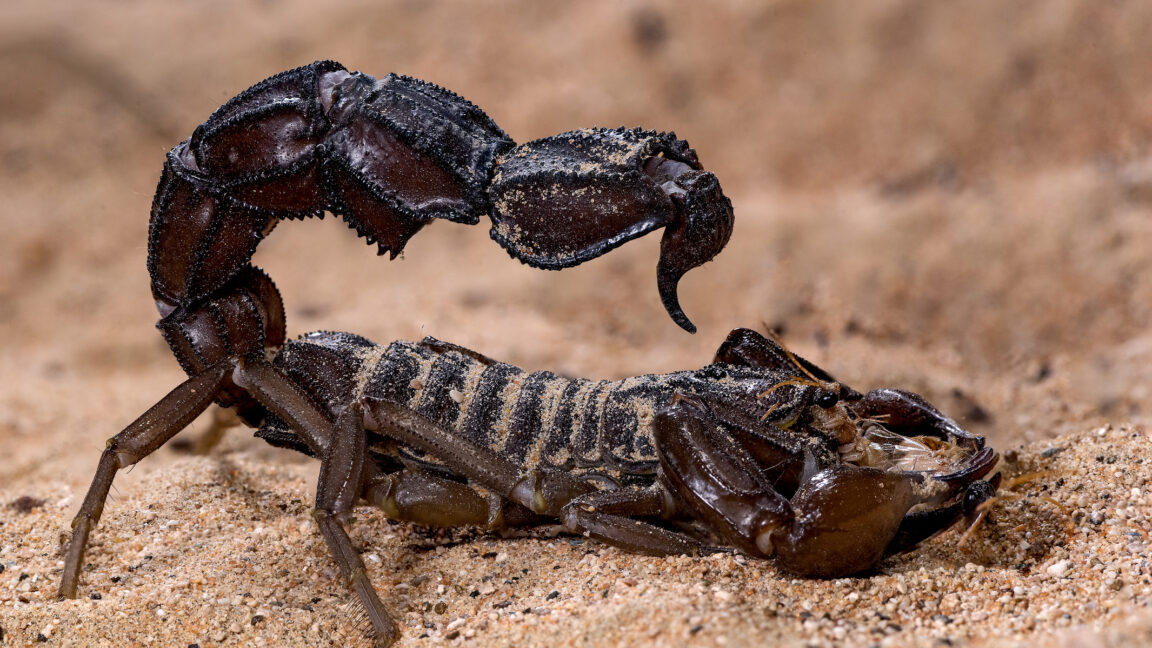
Scorpions are literally metal—researchers have confirmed these arachnids evolved to embed zinc, manganese, and iron in their weapons rather than accidentally absorbing them from the environment. A study published in the Journal of The Royal Society Interface examined 18 scorpion species using high-resolution scanning electron microscopy and X-ray imaging to map metal distribution across stingers and pincers.
The metal placement is remarkably precise. Zinc concentrates at the extreme tip of the stinger for hardness, while manganese below provides flexibility to absorb the force of aggressive stings. This arrangement creates a biological spear capable of punching through tough prey exoskeletons. In pincers, zinc and iron reinforce only the tooth-like denticles along the cutting edge—similar to how samurai swords concentrate the hardest material along their blade.
Different species show different metal patterns based on hunting strategy. The Buthidae family relies on venom, with slender pincers and highly reinforced stingers. The Emperor Scorpion uses massive claws to crush prey, reserving its stinger for defense. The study found an inverse correlation: scorpions with zinc-rich pincers have relatively zinc-poor stingers, reinforcing whichever weapon they use most.
One design flaw persists—stingers typically snap at the zinc-to-manganese transition zone. Researchers used only one specimen per species from museum collections, leaving individual variation and age-related changes unexplored.
Source: Ars Technica · Summarized by HeadlinesBriefing