
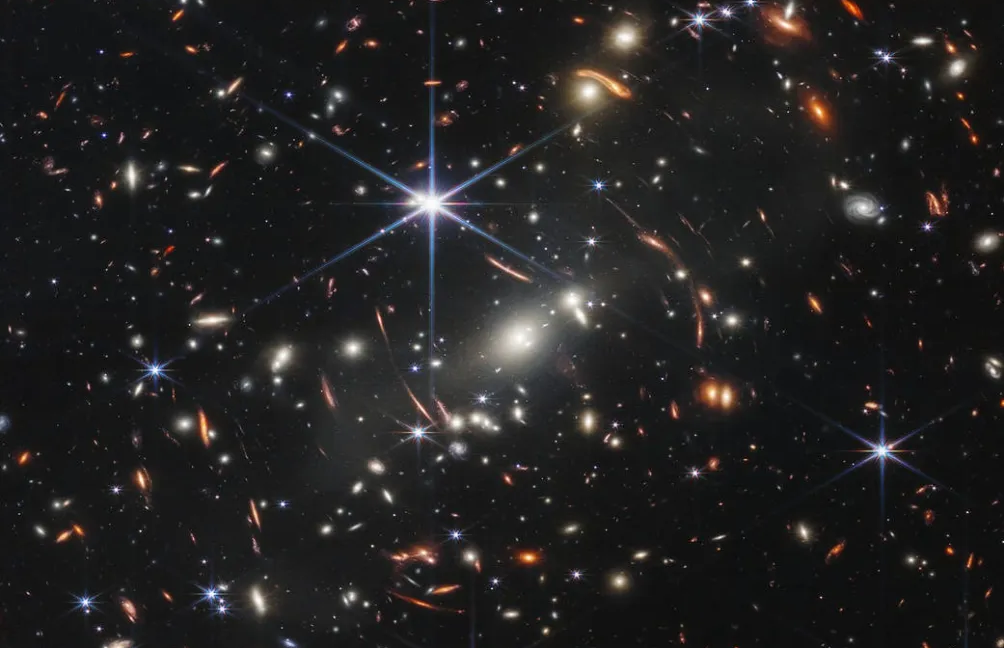
Astronomers using the James Webb Space Telescope, aided by a gravitational lens, have discovered LAP1-B, a galaxy existing just 800 million years after the Big Bang. The massive galaxy cluster MACS J046 warped spacetime, magnifying LAP1-B's light by 100 times, making the ultra-faint galaxy detectable. Analysis revealed LAP1-B has an extremely low 'metallicity'—its gas-phase oxygen-to-hydrogen ratio is only 0.4% of the Sun's, making it the most chemically primitive galaxy observed. Its light comes primarily from fluorescing interstellar gas, ionized by radiation from massive stars. This discovery provides a rare glimpse into the properties of the earliest galaxies, which were likely very small, metal-poor, and building blocks of the modern universe.
Key Points:
- LAP1-B was detected via JWST, using a 100x magnification from the gravitational lensing effect of galaxy cluster MACS J046.
- The galaxy is exceptionally metal-poor, with an oxygen abundance just 0.4% that of the Sun, indicating minimal enrichment from prior stellar generations.
- Its discovery offers direct evidence of the small, primitive galaxy building blocks that formed in the universe's first few hundred million years.
**
Source: Ars Technica · Summarized by HeadlinesBriefing