
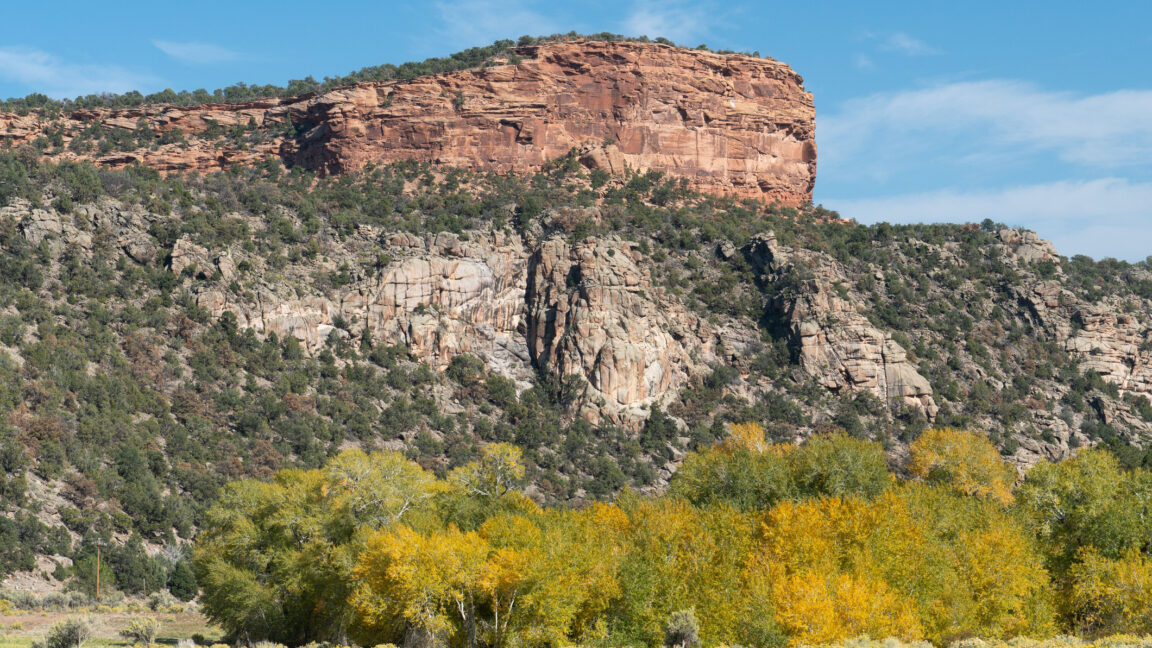
The Great Unconformity, a major gap in Earth's geologic record, is visible in Colorado where Cambrian sedimentary rocks rest atop older crystalline rocks. In the Grand Canyon, this boundary marks the transition from ancient rocks to sandstones formed during the Cambrian explosion. Nicolas Flament of the University of Wollongong, Australia, and his colleague Santosh Dhungana propose that slow mantle convection, not just glaciation, carved this gap.
Their Nature study suggests hot mantle currents uplifted continents for millions of years, enabling glacial erosion and subsequent burial by fresh sediments. The unconformity spans 635 to 482 million years and extends across North America, northern Europe, and northern China, but not globally, challenging Snowball Earth theories. While glaciers were effective at eroding rock, their global reach doesn't align with the localized distribution of the unconformity.
Rifting and sea-level changes are also considered but lack sufficient global impact. Flament's team ran six mantle convection simulations over 1 billion years, linking upwelling and downwelling zones to the formation and preservation of the unconformity. The amplitude of mantle-driven surface motion, estimated at several hundred meters, remains under investigation.
This research highlights deep-Earth processes as a potential key to one of geology's most mysterious gaps.
Source: Ars Technica · Summarized by HeadlinesBriefing