
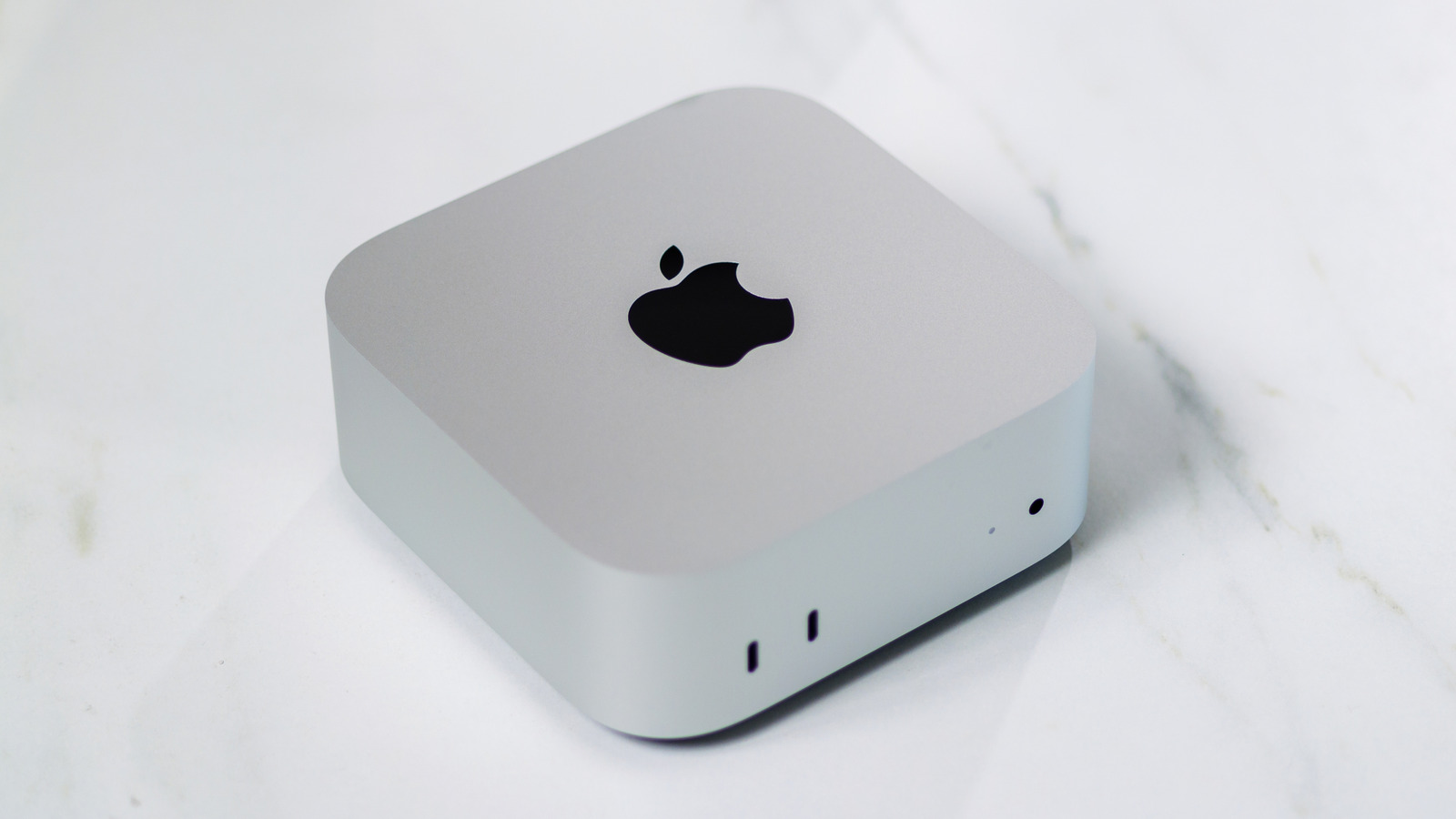
If you're trying to decide between a MacBook and a Mac mini, you might be interested to know why there's a price difference. If you're looking at base configurations, anyway. M21Perfect/Shutterstock For a while, the Mac mini was ranked as one of the best deals in computing.
Arguably, it's still pretty great. For $900, you can get a Mac with Apple's new M6 processor, which is vastly overpowered for most of the apps the average person runs. You might max it out if you're running something like Da Vinci Resolve or Resident Evil, but you're never going to touch its potential with an app like Safari or VLC.
The only real weak point is that the base mini ships with just 256GB of storage, which can run out quickly if you sync your personal photo and video collections. Strictly speaking, you can get a cheaper Mac Book in the form of the Neo, but that introduces serious compromises, like 8GB of RAM and the same A18 Pro processor found in the i Phone 16 Pro. The next step up, the Mac Book Air, is $1,100, and you're still stuck with an M5 chip and 16GB of RAM.
A Mac Book Pro might as well be in the stratosphere if you're searching for an affordable computer. The dichotomy between mini and Mac Book prices is pretty straightforward in most respects, owing to what's included versus what's not. But there are also deeper engineering elements at play.
In the end, a Mac Book Air might still be the most affordable option if you're planning to leap the hedges into Apple's walled garden. How is a Mac mini more affordable than a Mac Book Air? Erick PHOTOPRO/Shutterstock The most obvious cost factor is the absence of a display. Though Apple never publishes an official bill of materials for its products, a replacement Mac Book display can cost several hundred dollars if you're not covered by Apple Care.
The actual manufacturing cost is likely far lower — nevertheless, Apple not only has to pay for the panel, but also the frame, hinge and cabling it's anchored to. The mini ships without a display or an embedded Center Stage camera, not that it would make much sense to put a webcam on a computer you might shove in a cabinet. Also, while the mini has more ports than the Neo or Air — eight versus three, excluding dedicated power — it doesn't ship with any input peripherals.
There's no keyboard, and no mouse or trackpad. Those may be relatively cheap add-ons if you don't have existing ones, yet it's another way Apple slashes manufacturing costs and lowers the sticker price, if not necessarily the practical amount you have to spend. Another separator is the lack of a battery.
This probably doesn't cut costs as much as ditching a display, since Apple charges anywhere between $150 and $250 for Mac Book battery service, and that includes labor. Lithium-ion packs still aren't cheap, though, as anyone who's bought an EV or PEV will tell you. All the mini requires is an AC power supply.
Lastly, there are fundamental engineering differences between laptop and desktop computers. Although the mini does rely on some laptop-style components to achieve its form factor, it doesn't need to be thin, drop-resistant or maximally power-efficient. Its cooling system revolves around a giant circular vent at the base — something you could never get away with on a Mac Book.
Mobility and miniaturization are inherently expensive, which is part of how Apple can charge $700 for a Neo when the i Phone 16 Pro originally sold for $1,000. Does it make more sense to buy a Mac Book or a Mac mini? Kevin Carter/Getty Images If you're new to the Mac ecosystem and don't care about having a large screen, a Mac Book Air is almost always the better value. Yes, $1,300 is a big ask, and Apple has yet to upgrade it to the M6 chip as of this writing.
But you're getting a display, keyboard and trackpad out of the box, whereas you could easily spend more than that on peripherals for a Mac mini. You likely don't need the M6's performance, and going with a Mac Book gives you ...
Source: Engadget · Summarized by HeadlinesBriefing