
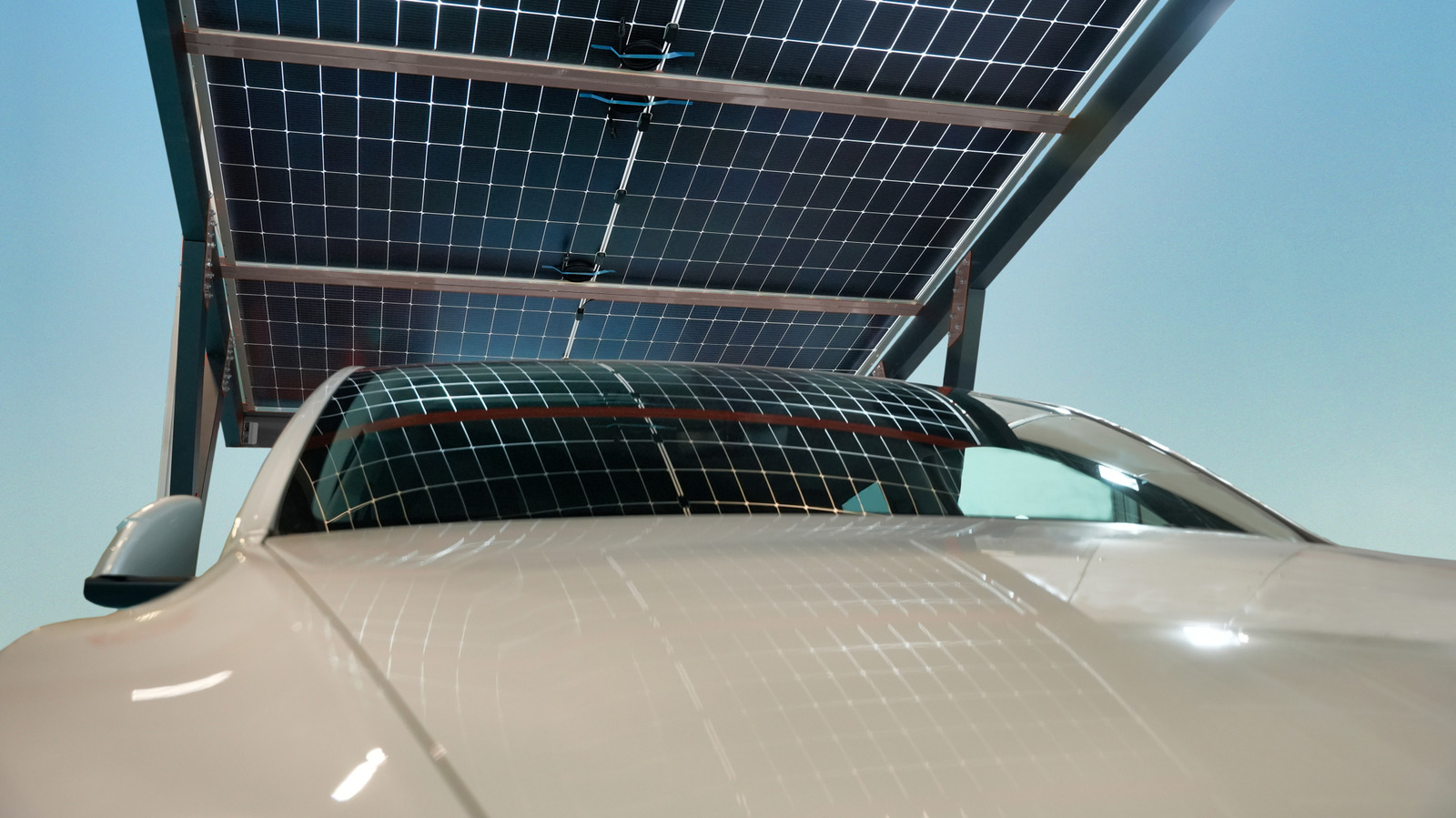
Solar roofs promise a future where EVs rarely need plugging in, but turning that vision into reality presents some surprisingly difficult challenges. A car roof can only catch so much sunlight, and adding more panels brings its own problems. Added weight requires electric motors to work harder and thus draw more energy.
Furthermore, extra hardware can compromise aerodynamics, increasing drag and lowering efficiency. Car makers are attempting to overcome these limitations by testing solar panels that can be stretched when a vehicle is parked, along with light EVs that can go further on each watt-hour. In comparison, RVs are better suited to rooftop solar since panels can be used to power lights, fans and refrigerators.
They're not expected to help move the vehicle. A solar roof can only generate so much electricity. Begin with the numbers.
The EPA estimates the median model-year 2025 EV uses 39k Wh per 100 miles, or 390Wh per mile. Let's assume that a 400W solar array is mounted on approximately 22 square feet of an EV's roof. If it generated its rated output for four hours, it would only produce 1.6k Wh before charging losses.
This is sufficient energy for approximately 4 miles at the EPA's average consumption rate. And that's assuming favorable conditions. Shade, cloudy weather, heat and unfavorable parking angles can all reduce solar output.
You also have limited roof space. Still, we can't help but think of Squad Mobility's tiny solar-powered EV, which pairs a 250W roof panel with a 794-pound city car. Larger arrays add weight and may increase aerodynamic drag, especially when mounted above the bodywork.
Panels that are integrated flush with the roof can largely avoid the aerodynamic penalty, but not the space issue. The compromise is demonstrated in Nissan's Ao-Solar Extender prototype for its Sakura EV, which generates up to 300W with the panel retracted for driving. When the car is parked, an extra panel slides over the windshield to increase the output to 500W.
The expandable configuration provides Nissan with more collecting area without a big panel protruding at highway speeds. Aptera's solution is a very different kind of EV. Instead of attempting to cram a massive solar panel on a traditional vehicle, Aptera has designed an EV featuring a teardrop-shaped body with three wheels, just two seats and lightweight composite construction.
That's quite different from the median model-year 2025 EV. Aptera is aiming for 100Wh per mile, which is about a fourth of the EPA's median EV consumption. Aptera's solar panels have delivered measurable results.
During July testing in Southern California, TÜV Rheinland measured 4.23k Wh delivered to an Aptera prototype's battery, with the car parked, untouched and its hatch closed. At Aptera's targeted efficiency, that equates to about 42 miles of solar range. That could translate to plugging in less often for someone who has a short commute and a sunny parking spot.
Still, garage parking, a few days of cloudy skies or a long road trip alters the equation. The test also confirmed the electricity collected, not how far the car could actually drive on it. History has shown that Aptera's goal isn't easy.
For example, Lightyear suspended production of its first solar EV in January 2023, just weeks after deliveries began. Lightyear's operating company, Atlas Technologies, entered bankruptcy days later. Aptera has yet to announce ...
Source: Engadget · Summarized by HeadlinesBriefing