
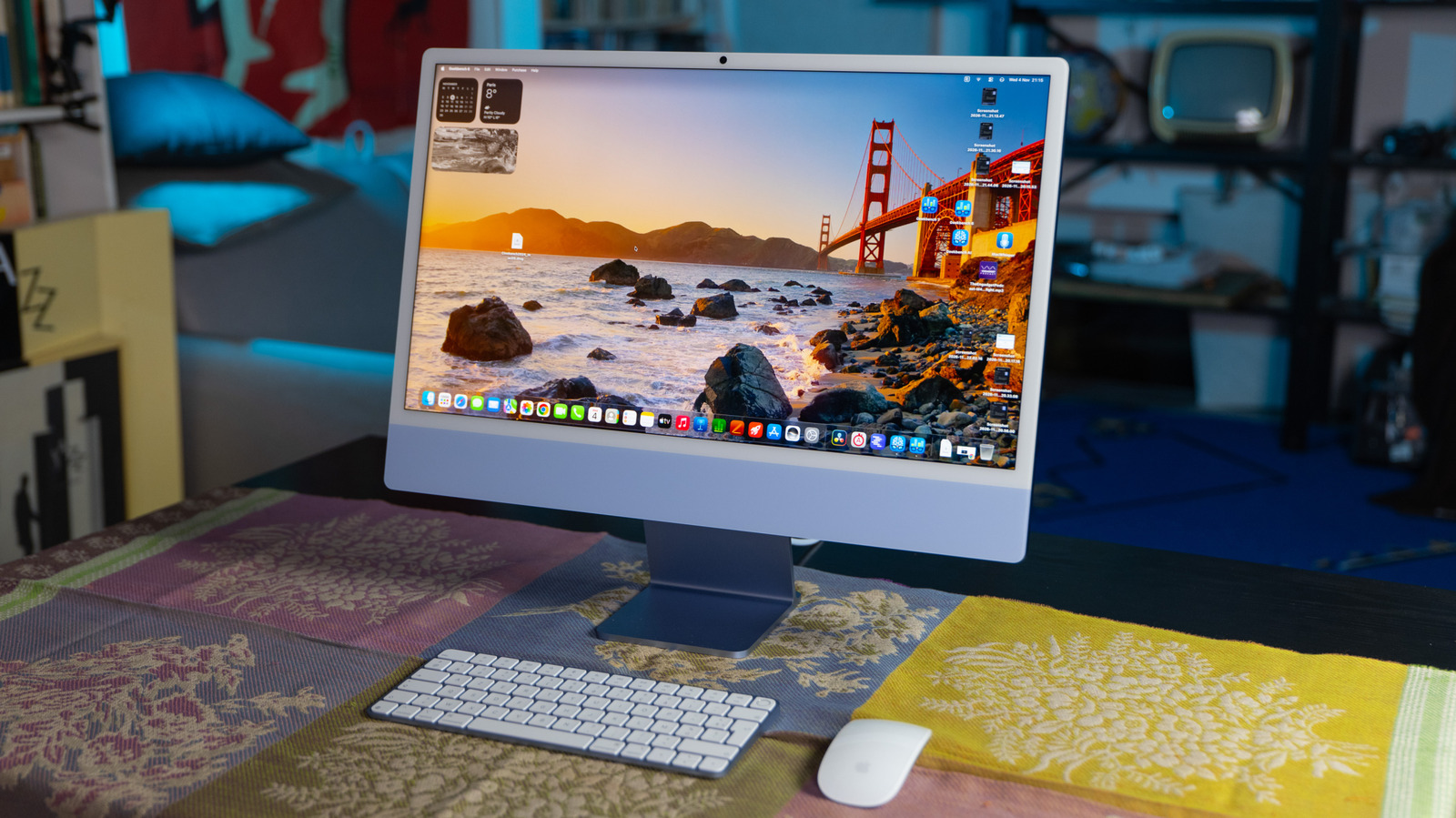
Most buyers would be better off with a Mac mini and a larger external display. With its new iPhone Duo and MacBook Pro touchscreen models, Apple is finally embracing change, but unfortunately the new iMac M6 all-in-one has not been a beneficiary of that new ethos. It is faster than ever thanks to the new M6 chip and updated memory. But the design, which hasn't changed since the 2021 iMac M1, is getting stale. The 24-inch display's small size is more of an issue than ever, considering that 27- and 32-inch monitors are now the norm. It's still a solid computer for consumers or business users, but at a $1,499 starting price ($200 more than before), there are better options including other Macs.
What's new for 2026: I tested the iMac M6 in a pretty, pale blue color, with the higher-end 12-core CPU, 12-core GPU (with a dual 16-core neural engine) and 16GB of memory. After recently reviewing a Mac Studio M5 Ultra with 256GB of RAM, I was curious to try a Mac model configured with the least amount of memory possible. Apple didn't release a new iMac last year, so the biggest change from the 2024 model is an upgrade from the M4 to the M6 processor. The new chip adds two extra cores to both the base and high-end models, with the latter offering up to a 12-core CPU and 12-core GPU instead of 10 cores for both as before. Apple says that memory bandwidth is higher as well at 170GB/s max, compared to the previous 120GB/s. The new model also comes with Apple's latest N1 wireless chip, so it now supports Wi-Fi 7 and Bluetooth 6, compared to Wi-Fi 6E and Bluetooth 5.3 on the iMac M4.
Otherwise, the new iMac is the same old iMac. It still comes with a 24-inch 4.5K (4,480 x 2,250) 500-nit IPS display, available with and without a nano-textured coating that reduces glare (a $200 option). The elegant stand still has a tilt but not a height adjustment, and it offers four Thunderbolt 4 ports on the higher-end model and two on the base version. Other features carried over from before include the magnetic power connector, 3.5mm headphone jack and sharp 12-megapixel webcam introduced on the last model. The iMac is available with the same seven color options as before, including blue, green, pink, yellow, purple, orange and silver, with accessories (the mouse, keyboard and cables) in matching shades. The colors on the front are subdued, but they're more saturated on the back.
In-use: Big speeds, small screen: Since the iMac skipped the M5 chip, the M6 model is noticeably quicker than before. Apple claims it's up to 50 percent faster for productivity apps like Microsoft Excel compared to the last model, while offering a similar speed bump for things like photo and video editing. The M6 chip is particularly proficient for AI, with Apple claiming five times faster on-device performance in LM Studio compared to the M4 model. However, keep in mind that AI models work best with plenty of memory and the iMac only offers 16GB, 24GB or 32GB configurations tied with the MacBook Air for the least of any Mac product. In my tests, performance largely lived up to Apple's claims. The iMac M6 scored 4,552 and 20,363 points on Geekbench 6's single- and multi-core CPU tests, around a 20 percent bump from the previous model. It did even better on Geekbench 6 GPU (metal) with a mark of 88,276, more than double the previous model. Cinebench 2024 scores were also up 38 percent on the GPU side and 25 percent/40 percent in single/multi-core tests compared to the iMac M4. Finally, the M6 iMac scored 81,050 on Geekbench AI ML, a significant increase from 50,704 before.
Source: Engadget · Summarized by HeadlinesBriefing