
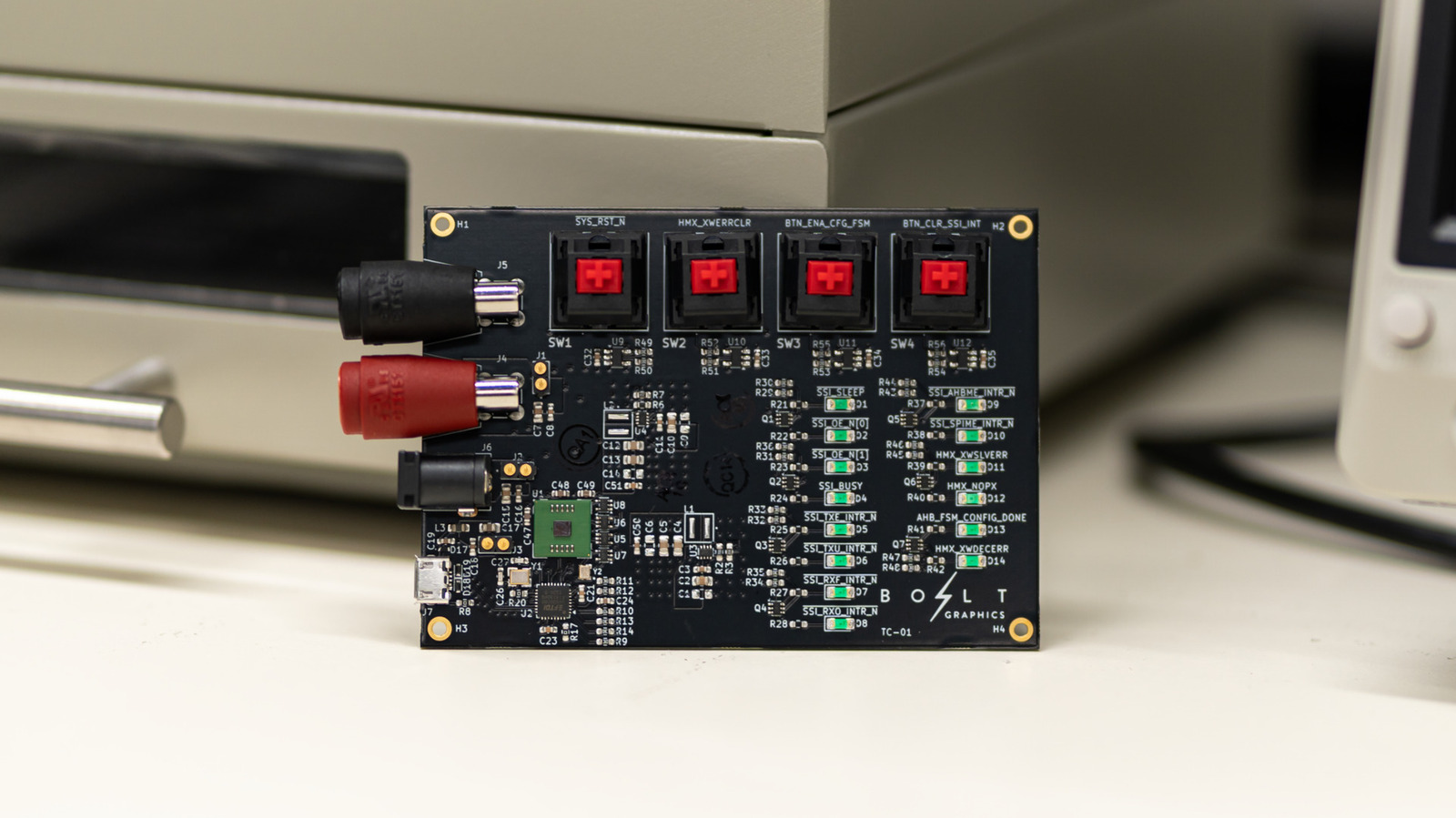
Bolt Graphics has successfully powered on its first Zeus GPU test chip, a milestone in the development of its simulation-centric graphics processor. The 12nm test chip, manufactured by TSMC, ran without issues and measures just 6mm² while drawing only 1.4 watts — a significant improvement over the 35-watt FPGA previously used for prototyping. The chip features dedicated hardware for electromagnetic simulation, enabling advanced applications in radar, optics, and scientific computing. Bolt CEO Darwesh Singh stated the chip successfully ran a complex physics algorithm accelerated in hardware, a feat no competitor has achieved. However, no performance figures have been published, and the claims remain unverified.
The actual Zeus GPU will be built on TSMC’s N5P process node and is not expected to reach volume production until 2028. It will use RISC-V cores paired with Bolt’s proprietary path-tracing hardware and support up to 384GB of memory via LPDDR5X and DDR5 SO-DIMM slots. Bolt claims Zeus will deliver 10x the rendering performance and 300x the electromagnetic simulation speed of existing GPUs, including Nvidia’s RTX 5090. The company is targeting studios, engineers, and scientists first, with plans to enter gaming and AI markets later. Over 14,000 users have signed up for early access, and Bolt projects a product pipeline worth over $500 million.
Source: Engadget · Summarized by HeadlinesBriefing