
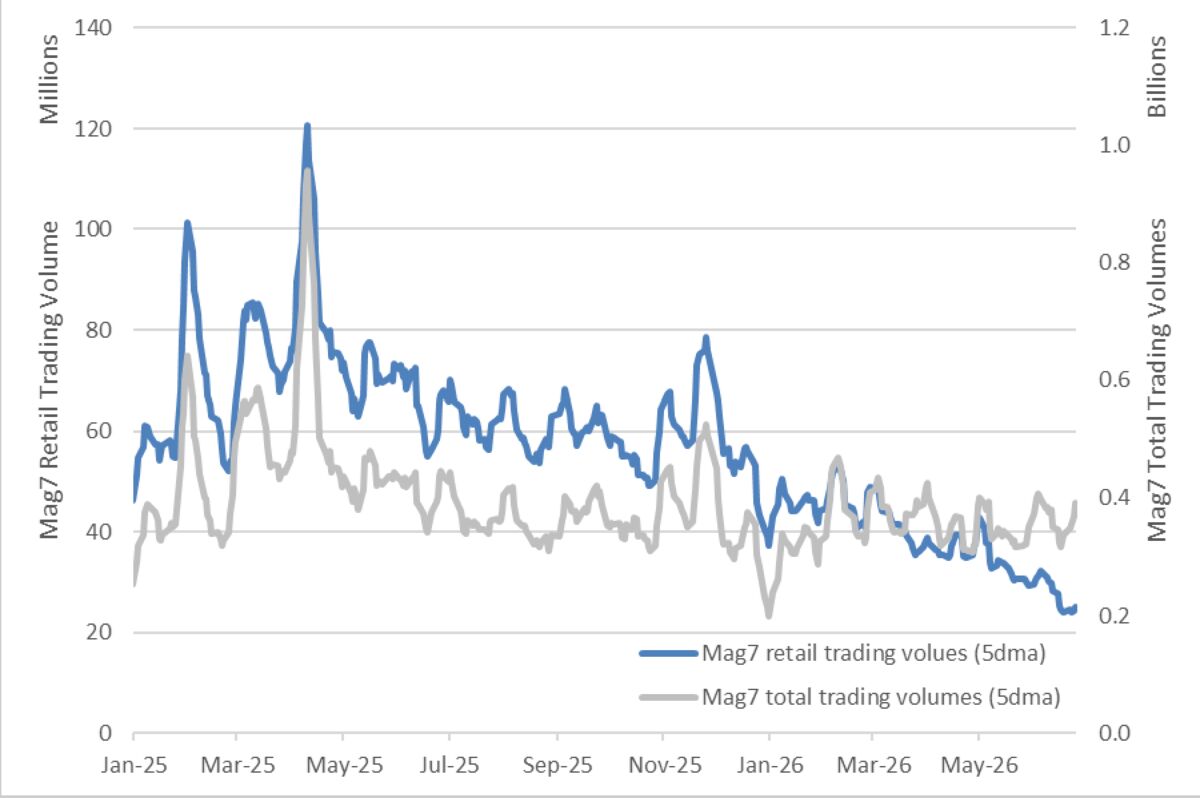
Magnificent Seven stocks saw retail investor activity hit a four-year low recently, per Citigroup Inc. strategists, signaling a sharp reversal from prolonged muted participation. This shift contrasts sharply with the tech megacaps' earlier dominance, where retail enthusiasm fueled soaring valuations. The cooldown follows months of subdued trading, suggesting investor wariness amid volatile market conditions. Citigroup highlights that magnificent seven holdings now account for a smaller share of retail portfolios, pointing to broader diversification trends. The drop isn’t just numerical; it reflects a cultural pivot where retail investors, once synonymous with YOLO (You Only Live Once) bets on tech, are retreating. This behavioral change could pressure growth stock valuations, especially if profit-taking accelerates. While institutional buyers remain active, retail absence risks creating imbalances, particularly in smaller-cap tech segments reliant on retail liquidity.
The decline in retail engagement with technical megacaps raises questions about sustainability. For months, retail investors had scaled back bets on AI-driven giants like Microsoft, Alphabet, and NVIDIA, citing overvaluation or macroeconomic uncertainty. Citigroup’s data implies this isn’t a temporary pause but a structural shift. Historical parallels suggest such withdrawals often precede sector rotations, though tech’s resilience might delay rebalancing. The four-year low in retail activity also underscores how quickly sentiment can reverse in markets dominated by high-growth narratives. Investors who once celebrated YOLO trading now face a reality check, with many reallocating to safer assets or diversified baskets. This erosion of retail confidence could test tech stocks’ ability to sustain momentum without retail momentum as a catalyst.
The implications extend beyond individual stocks. A sustained decline in retail participation might signal a maturing market phase for technical megacaps, where growth stories are harder to justify at current valuations. Citigroup’s analysis doesn’t speculate on future prices but emphasizes behavioral economics: retail investors are reacting to perceived overvaluation rather than fundamentals. This disconnect could lead to sharper corrections if retail sentiment doesn’t rebound. However, tech’s dominance in indices like the S&P 500 means short-term volatility remains likely. The key takeaway is that the magnificent seven’s allure has dimmed for many retail participants, marking a potential inflection point in their trajectory. This shift isn’t just about money moving out—it’s about a narrative shift where tech’s once-universal appeal is now scrutinized.