
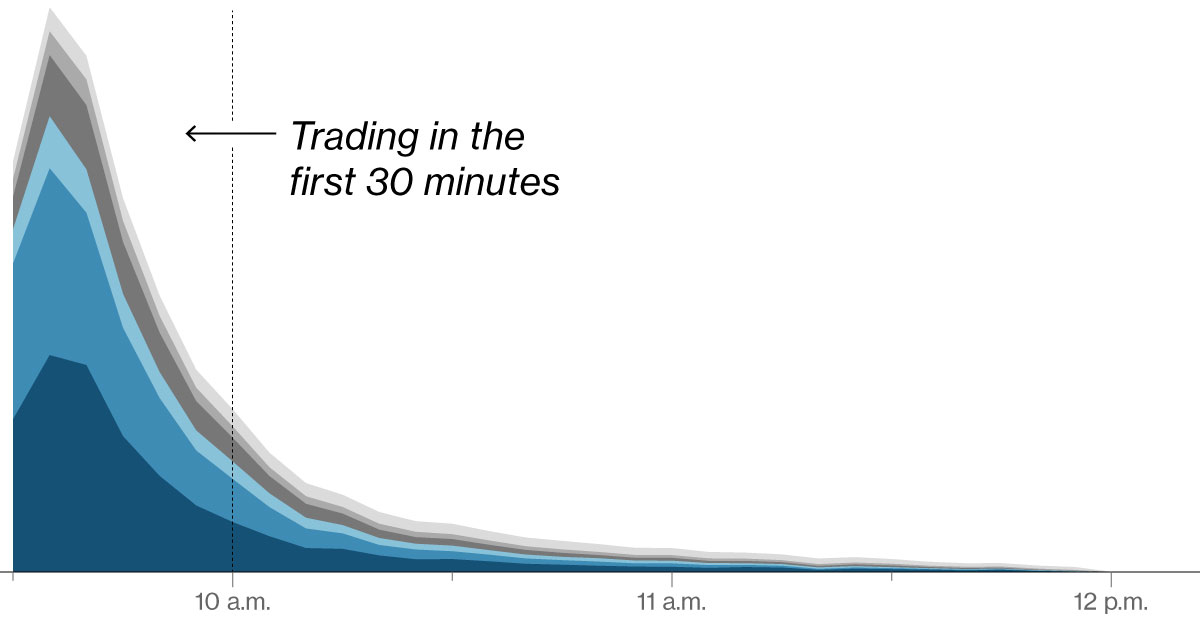
Every weekday at 9:30 a.m. in Hong Kong, the world's biggest warrants market opens with a rapid-fire burst of trading. Large blocks of derivative warrants and callable bull/bear contracts, products that allow investors to make highly leveraged bets, zip repeatedly between accounts. According to Bloomberg data compiled for August through October, about two-thirds of the volume in the usual 5.5-hour trading day appears within the first 30 minutes. That is extreme by almost any standard. In Germany, home to the world's second-biggest warrants market, the figure is less than 4%. It is 18% in Hong Kong's cash equities market and 8% on the New York Stock Exchange.
Few market participants in Hong Kong are willing to speak openly about the phenomenon, but in private they nearly all agree that the morning flurry has the telltale signs of artificially inflated trading. More than a dozen current and former traders, bankers and investors said these "ping pong" transactions, in which issuers trade back and forth with select counterparties at minimal price changes, are meant to make certain warrants appear more in-demand than they really are. Such trades are likely designed to boost the products' positions in widely followed volume rankings, which are prominently displayed on local trading apps and are one of the surest ways to attract individual investors in a market with some 13,000 products.
Wei Lai, head of the finance department at Lingnan University in Hong Kong, said the market is very competitive, with no single big player, so participants may have incentives to make their products more visible and attractive to retail investors. The activity casts doubt on the integrity of a market that recorded $577 billion of turnover in 2025, more than three times the combined total of the next five-biggest warrants markets.
Market participants say it is difficult to quantify how much of the morning spike is due to ping pong trades. No specific issuers have been called out, and there is no indication issuers are pumping up warrant prices to sell them to investors at excessive valuations. Still, several people familiar with the matter described ping pong transactions as a notable feature of the Hong Kong market.
Source: Bloomberg Markets · Summarized by HeadlinesBriefing