
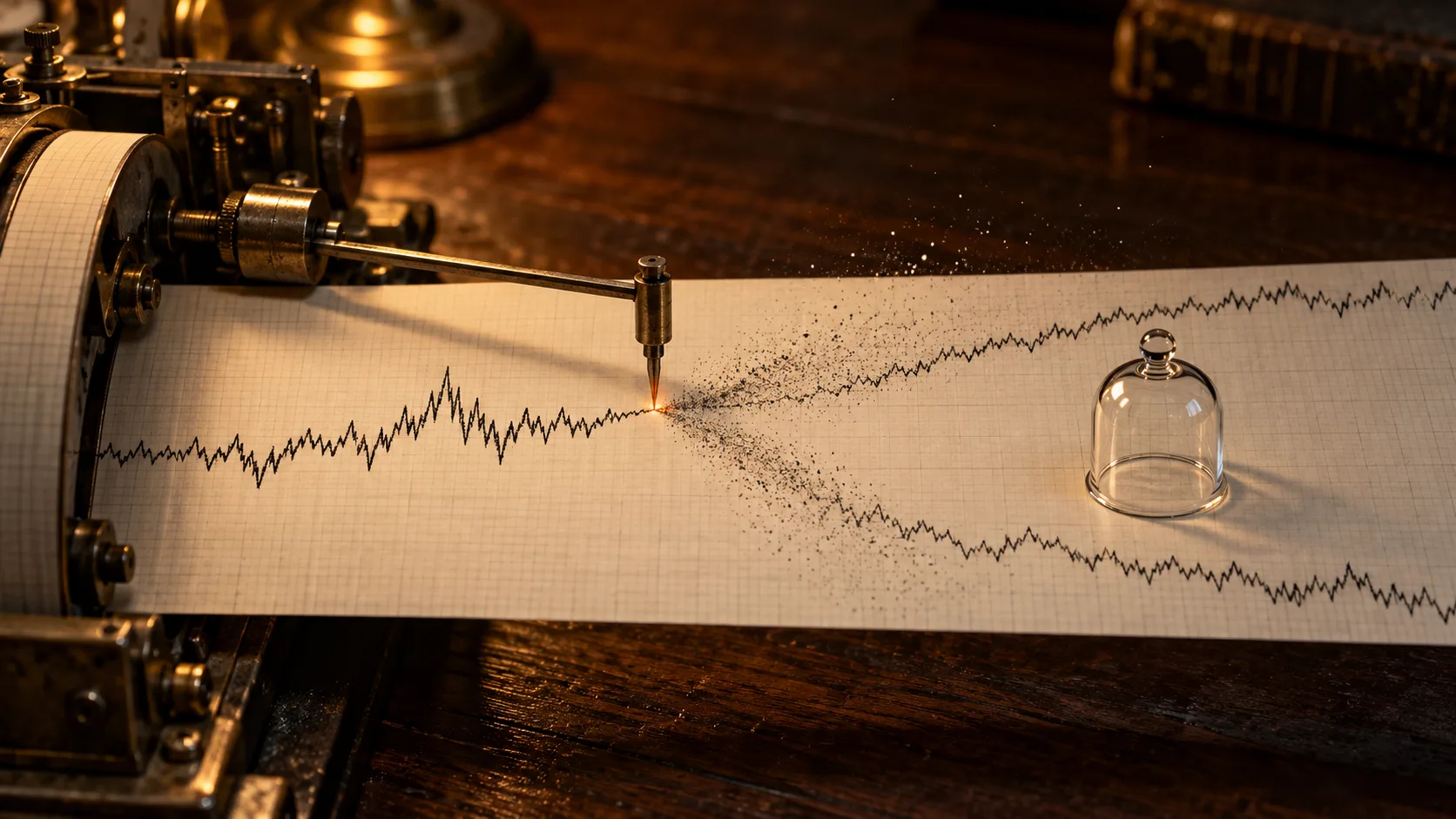
Earlier parts of this series showed that a model can match another on MSE while carrying very different risk, and that a mean and variance head, once rolled out over time, still assume a single symmetric bell curve. This part focuses on the shape of uncertainty. For signals that drift and jitter, a bell curve is a reasonable description. For signals that can jump, switch regimes, or sit on a threshold and move either way, it is not. A model can have exactly the right mean and variance and still describe a future that never happens.
The article moves from one bell curve to a mixture of several, then to infinitely many, which can express any shape but is hard to train. Diffusion models offer a way out. Noise is gradually added to the signal and then removed by a network, which learns what to subtract at each step. The resulting training loss turns out to be MSE, and the article explains why that is acceptable here. A forecast value is then drawn by sampling through this learned denoising process.
The diffusion head is plugged into the sampled rollout from Part II without changing anything else. The author stresses that the explanation is deliberately thorough, that no prior knowledge of diffusion models is required, and that a companion notebook reproduces every figure. A roadmap of nine stops guides the reader through the theory before the data and experiments appear.
Source: Towards Data Science · Summarized by HeadlinesBriefing