
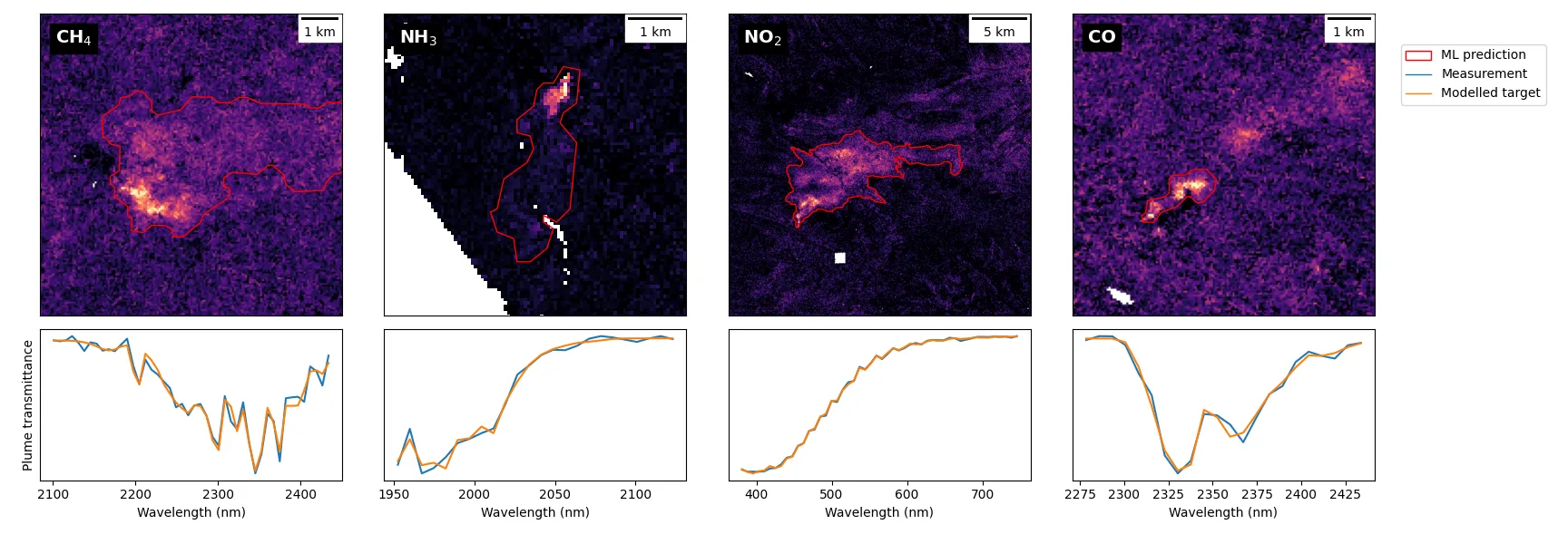
A machine learning model trained on methane successfully detected carbon monoxide, ammonia, and nitrogen dioxide emissions from space without retraining. Developed by NASA’s Jet Propulsion Laboratory, the Daily Methane Digest pipeline uses matched filter enhancement, U-Net segmentation, and physics-informed scoring to identify gas plumes with minimal false alarms. This system enables automated, near-real-time monitoring of toxic pollutants and greenhouse gases from orbit.
The pipeline processes hyperspectral data from NASA’s EMIT instrument, which captures 285 wavelength channels per second. By decoupling spectral chemistry from spatial morphology, the model learns fluid-dynamic patterns rather than surface features, improving generalization. It reduces alert latency from months to approximately 24 hours and achieves zero-shot detection of unmodeled gases.
Published in Nature Scientific Reports, the method addresses the base-rate fallacy in satellite gas detection—where rare plumes are buried in vast datasets. The architecture filters out false positives caused by terrain, buildings, and sensor noise, making full automation viable for environmental monitoring and public health applications.
Source: Towards Data Science · Summarized by HeadlinesBriefing