
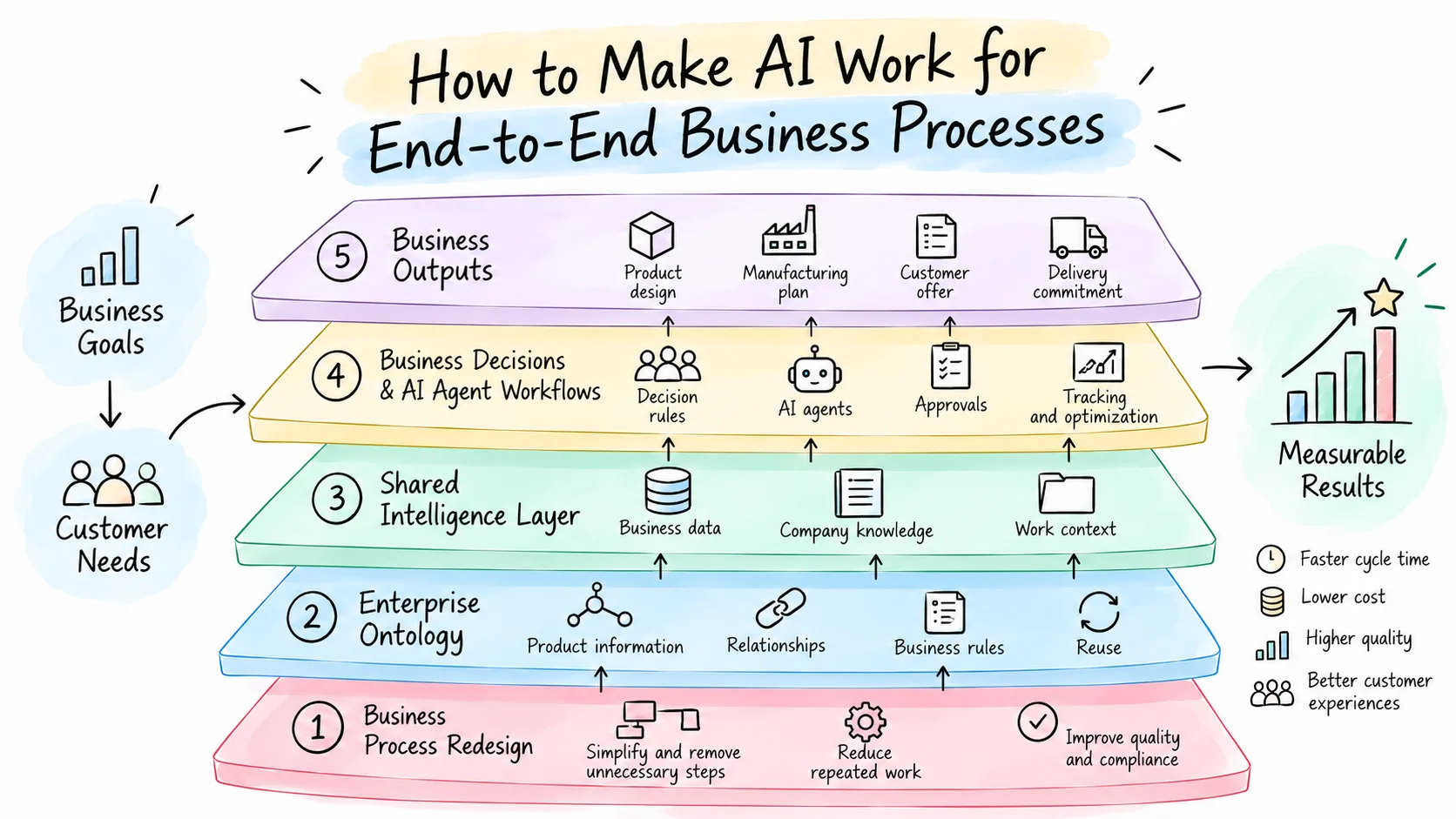
As AI becomes part of everyday work, more companies are looking at how to improve the way teams work together across the business. With new capabilities like Palantir Foundry Ontology, Databricks Genie Ontology, Microsoft Fabric IQ, and Open AI Frontier, the goal is to bring them together to make work easier and more efficient, from product development and manufacturing to sales and customer delivery. A practical starting point is to focus on one specific business deliverable, such as a customer offer with the right product, price, and delivery commitment, and work with business and process owners to simplify how it gets done.
The approach centers on five areas: simplifying how work gets done, establishing a shared enterprise ontology, building a shared intelligence layer, connecting business decisions to AI agent workflows, and linking AI directly to business outputs. Simplifying work means identifying where teams repeat effort, wait for approvals, or manually pass information between systems, then removing unnecessary steps while keeping quality checks. In one AI-assisted packaging review workflow, review time dropped from six hours to an average of 30 minutes, and the overall cycle went from eight to four weeks.
A shared enterprise ontology ensures different teams work from the same product information and business rules. This means confirming product identity across engineering, manufacturing, and sales, which may use different codes, and connecting customer needs with specifications, components, and delivery commitments. Business rules for compatibility, quality, pricing, and delivery should be unified so that engineering, manufacturing, and sales agents draw on the same approved information.
AI can help identify possible matches between inconsistent records, but responsible teams still need to confirm them. Once results are measured, the same approach can be applied to other workflows.
Source: Towards Data Science · Summarized by HeadlinesBriefing