
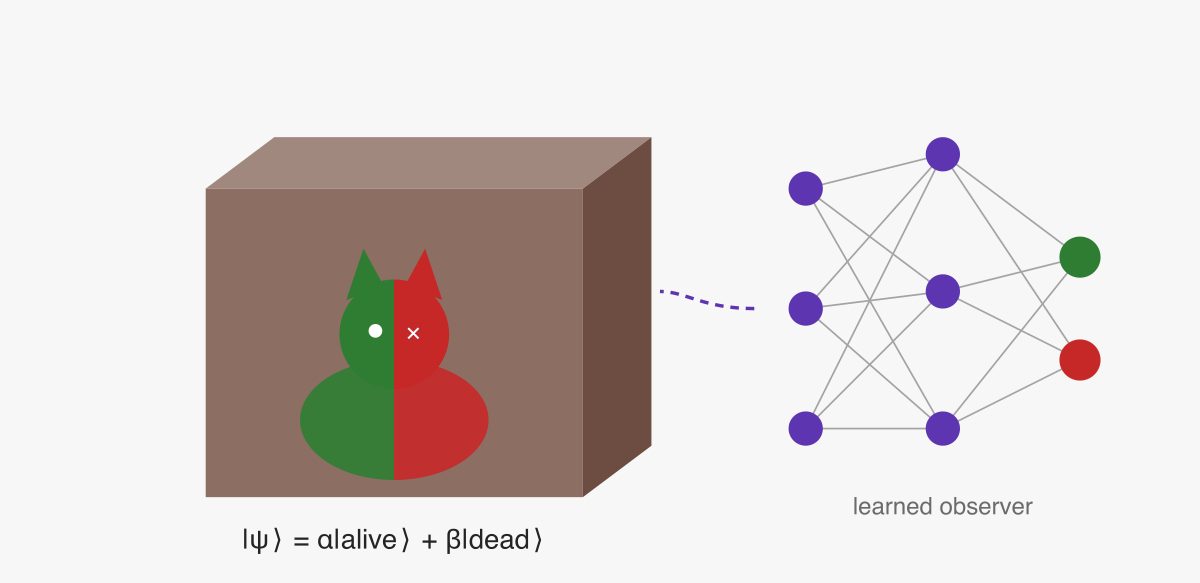
In 1935 Erwin Schrödinger proposed his famous thought experiment: a cat in a sealed box with a radioactive atom, Geiger counter, and poison vial is simultaneously alive and dead until observed. Ninety years later, physicists still debate what "looking" actually means. Machine learning has now entered nearly every scientific field, prompting the question: can ML resolve Schrödinger's cat? The honest answer is twofold. ML cannot settle the philosophical measurement problem—what reality is—because no curve-fitting can answer it. However, ML can tackle the operational version: determining the state inside the box, predicting when superposition collapses, and delaying that collapse. These problems are critical for quantum computing.
The cat thought experiment actually conceals three distinct problems: the measurement problem (why a deterministic wavefunction becomes one outcome), the quantum-to-classical transition (why we never see cat-sized superpositions in daily life), and the state-estimation problem (reconstructing a state from limited destructive measurements). The first belongs to philosophy; the latter two are empirical and data-driven. Decoherence theory reveals that the cat does not remain "mysteriously both" for long—its trillions of atoms entangle with the environment within approximately 10⁻²⁰ seconds. The superposition does not vanish but leaks into the surroundings, a process that can be modeled and, therefore, learned.
In 2018, Torlai, Carleo, and colleagues demonstrated in Nature Physics that a Restricted Boltzmann Machine can learn a compact representation of a many-body wavefunction from a manageable number of measurement snapshots. This neural quantum state (NQS) reconstructs the entire quantum state from partial data, much like a Variational Autoencoder (VAE) generates images from samples. The test system uses a GHZ "cat state": (|000…0⟩ + |111…1⟩)/√2, where all qubits are either "alive" or "dead" together. A well-trained model identifies this two-faced nature in the data. Real superpositions decay due to interactions with stray photons, phonons, and magnetic noise. ML can predict this decoherence timeline and help protect quantum states long enough for quantum computers to function.
Source: Towards Data Science · Summarized by HeadlinesBriefing