
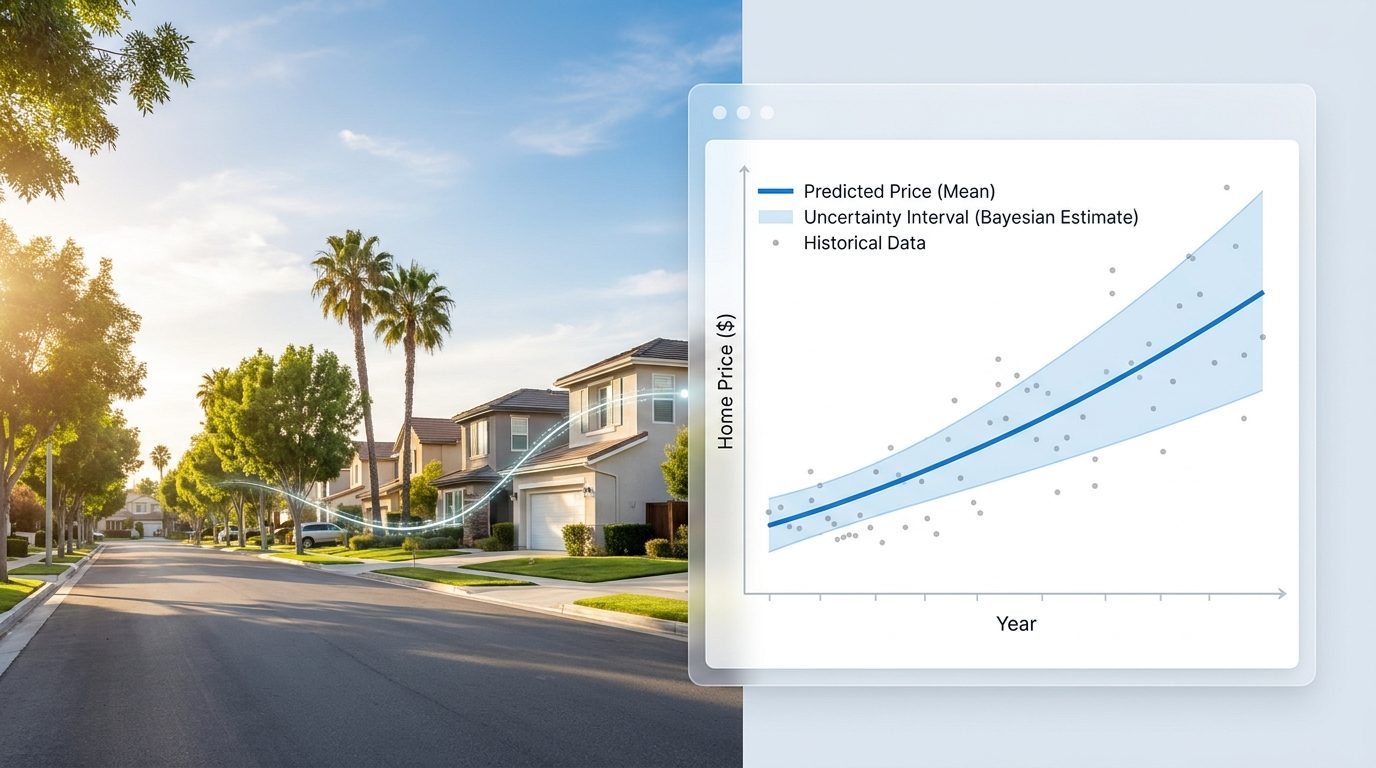
Standard neural networks output single point estimates, like a $385,000 house price, which hide underlying uncertainty. This limits decision-making, as metrics like MAE only reflect average error across datasets, not confidence in individual predictions. Bayesian Neural Networks (BNNs) address this by estimating a range of plausible values and quantifying model confidence.
Instead of asking 'What is the predicted value?', BNNs answer 'What is the range of plausible values, and how sure are we?' This shift enables better risk-aware decisions in applications like automated valuation. Implementing BNNs involves parameterizing weight distributions and using variational inference, since exact Bayesian computation is intractable for networks with thousands of parameters. The article uses the California Housing dataset and Python notebooks to illustrate key engineering choices, such as prior selection and inference methods.
Each notebook highlights one design decision, emphasizing that production systems should combine multiple strategies. A core concept discussed is uncertainty quantification, distinguishing between epistemic uncertainty (model ignorance due to unseen data) and aleatoric uncertainty (inherent data noise). While philosophically separate, research shows these uncertainties are often mathematically intertwined in practice, complicating clean separation.
The piece stresses that understanding these trade-offs is essential for building trustworthy AI systems that know when to trust or doubt their predictions.
Source: Towards Data Science · Summarized by HeadlinesBriefing