
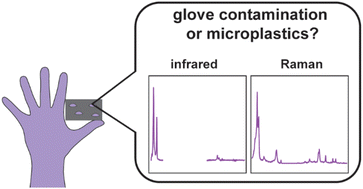
Researchers at the University of Michigan have shown that dry contact with common laboratory gloves can inflate microplastic counts in environmental samples. Using infrared and Raman library matching, they measured an average of 2000 false positives per mm² when samples touched nitrile or latex gloves. The contamination stems from stearate salts left on glove surfaces, whose vibrational spectra mimic synthetic polymers.
To curb this bias, the team recommends switching to a nitrile cleanroom glove, which produced only about 100 false positives per mm² under identical tests. They also compiled spectral libraries of pure stearate standards and devised a workflow that flags glove‑derived peaks during data processing. Applying the method to a contaminated dataset trimmed false detections, especially for particles smaller than 10 µm.
By integrating these protocols, labs can generate more reliable microplastics inventories, a prerequisite for assessing pollution sources and mitigation strategies. The authors made all supplementary spectra and code publicly available, encouraging broader adoption across analytical chemistry groups. Ultimately, distinguishing genuine polymer fragments from glove residue sharpens the accuracy of environmental monitoring programs for regulatory reporting and public health assessments.
Source: Hacker News · Summarized by HeadlinesBriefing