
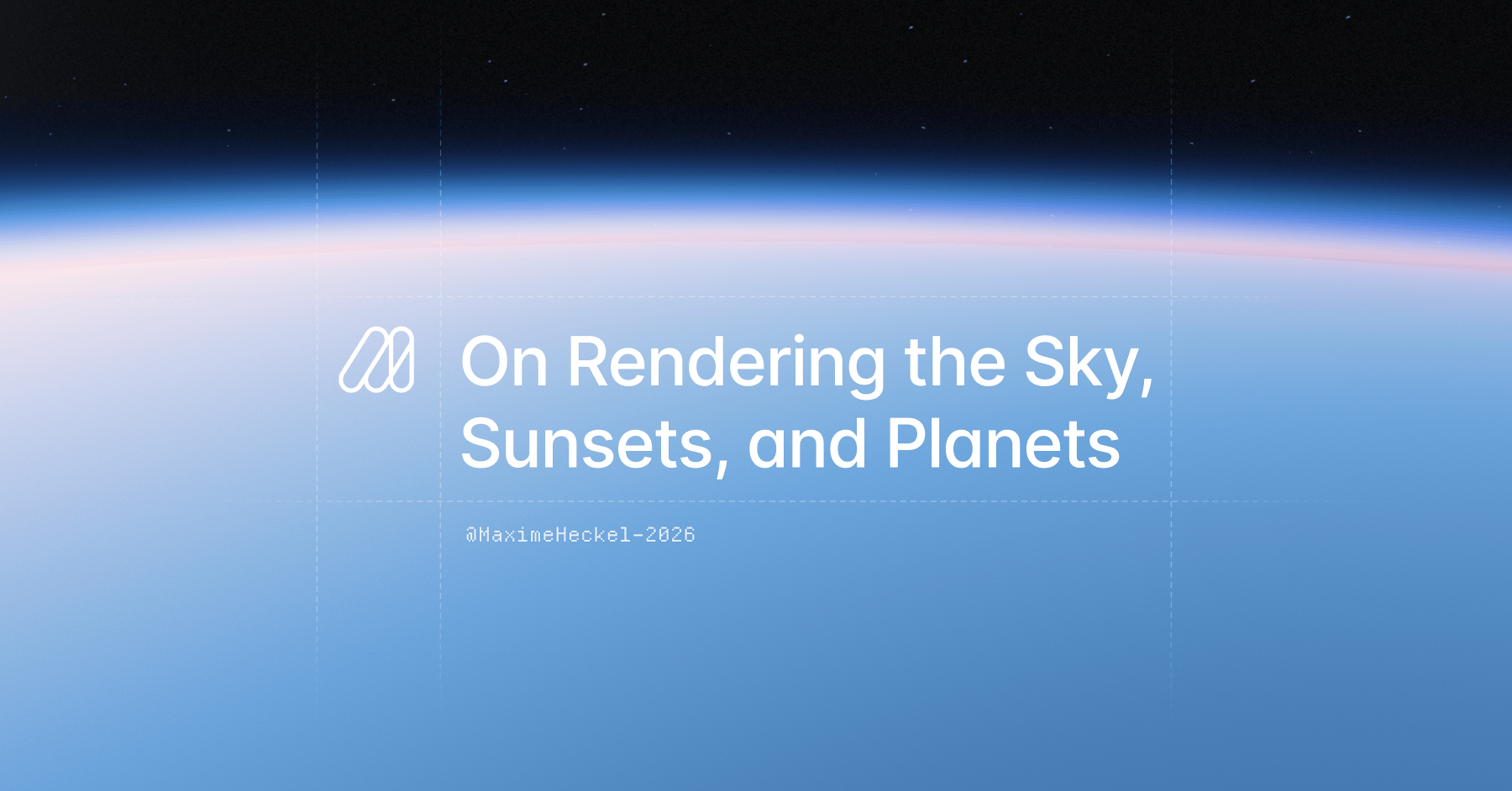
Atmospheric scattering shaders enable browser-based rendering of realistic skies, sunsets, and planetary atmospheres through meticulous simulation of light physics. Maxime Heckel’s project replicates NASA’s iconic Endeavour shuttle photo by modeling how sunlight interacts with atmospheric particles, creating true-to-life color gradients and haze effects.
The core implementation uses raymarching to calculate light transmittance and scattering across 24 steps per ray, accounting for altitude-dependent Rayleigh scattering (which favors blue wavelengths) and Mie scattering for aerosols. A key technical challenge involved replicating the optical depth accumulation process, where atmospheric density decreases exponentially with altitude, mimicking real-world conditions.
To enhance realism, Heckel incorporated Mie scattering for dust particles and ozone absorption effects, which deepen twilight hues. The shader adapts NASA’s atmospheric density models, using a 100km atmospheric height parameter and 8km Rayleigh scale height to balance computational efficiency with visual accuracy.
The final result achieves sub-10ms rendering times through optimized GLSL code, with interactive controls for time-of-day adjustments. This work bridges game development techniques and scientific visualization, offering developers a framework to create plausible celestial environments without sacrificing performance.
Source: Hacker News · Summarized by HeadlinesBriefing