
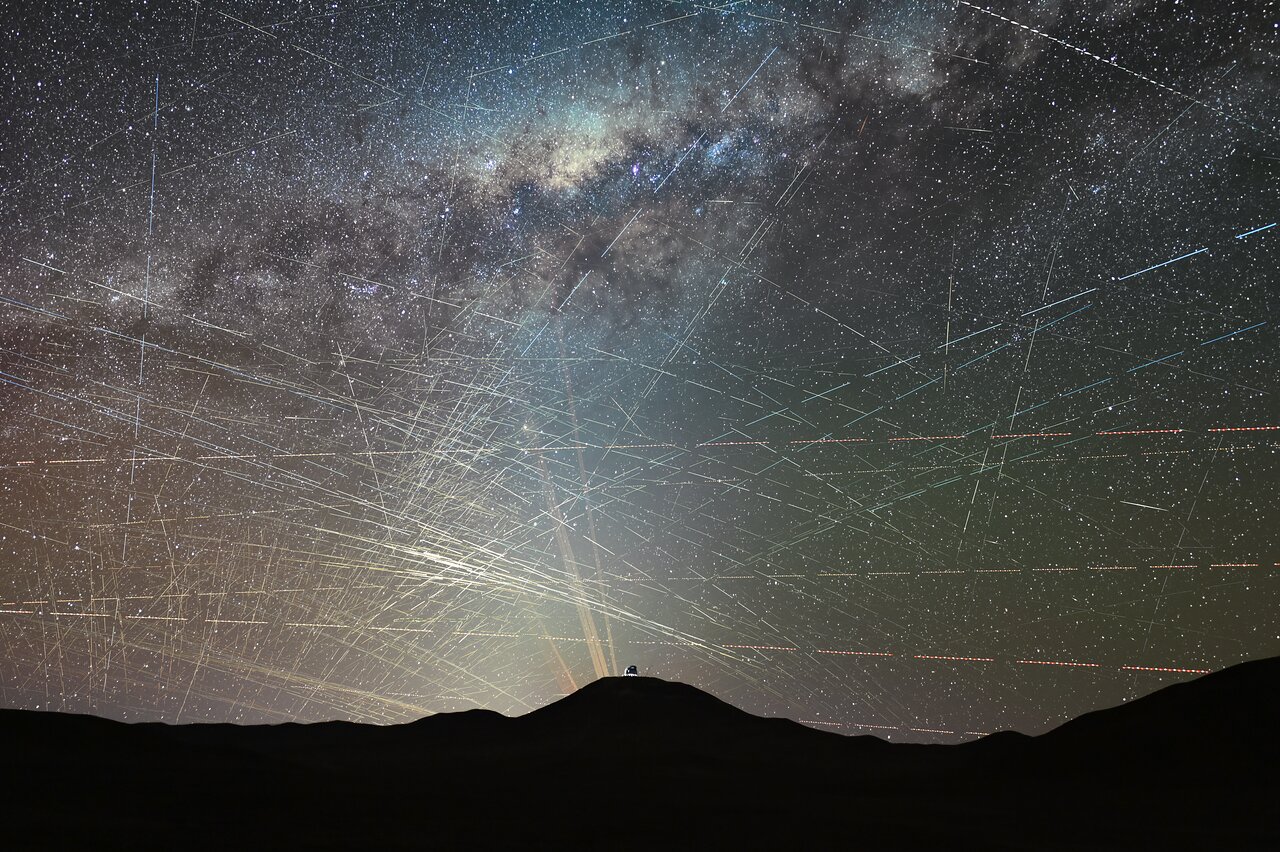
A new European Southern Observatory study warns that proposed satellite launches totaling 1.7 million objects would devastate ground-based astronomy. The research, led by astronomer Olivier Hainaut, finds that current satellite proliferation already creates bright streaks across telescope images, obscuring distant galaxies and exoplanets. With over 14,000 satellites currently orbiting Earth—dominated by SpaceX's Starlink constellation—the problem grows more urgent daily.
The most extreme proposals come from Reflect Orbital, a U.S. startup planning 50,000 mirror-like satellites that could make the night sky up to four times brighter. These would appear four times brighter than the full Moon when their beams hit Earth's surface. Meanwhile, E-Space's Cinnamon and Chinese CT C-1 and 2 constellations add hundreds of thousands more planned satellites, compounding the threat to optical astronomy worldwide.
Hainaut's simulations show dozens of satellite trails appearing in each image captured by ESO's Very Large Telescope, causing up to 28% field-of-view losses. The Vera C. Rubin Observatory faces potential image degradation for several hours nightly. Even satellites below naked-eye visibility contribute diffuse light pollution, brightening the entire sky and drowning out faint cosmic targets that astronomers study to understand our universe.
The study recommends limiting total satellites to 100,000 objects dimmer than visual magnitude 7—fainter than what human eyes can detect from dark locations. ESO, the Royal Astronomical Society, and the International Astronomical Union have submitted responses to the FCC regarding these satellite filings, calling the threat existential for ground-based astronomy and demanding strict mitigation measures.
Source: Hacker News · Summarized by HeadlinesBriefing