
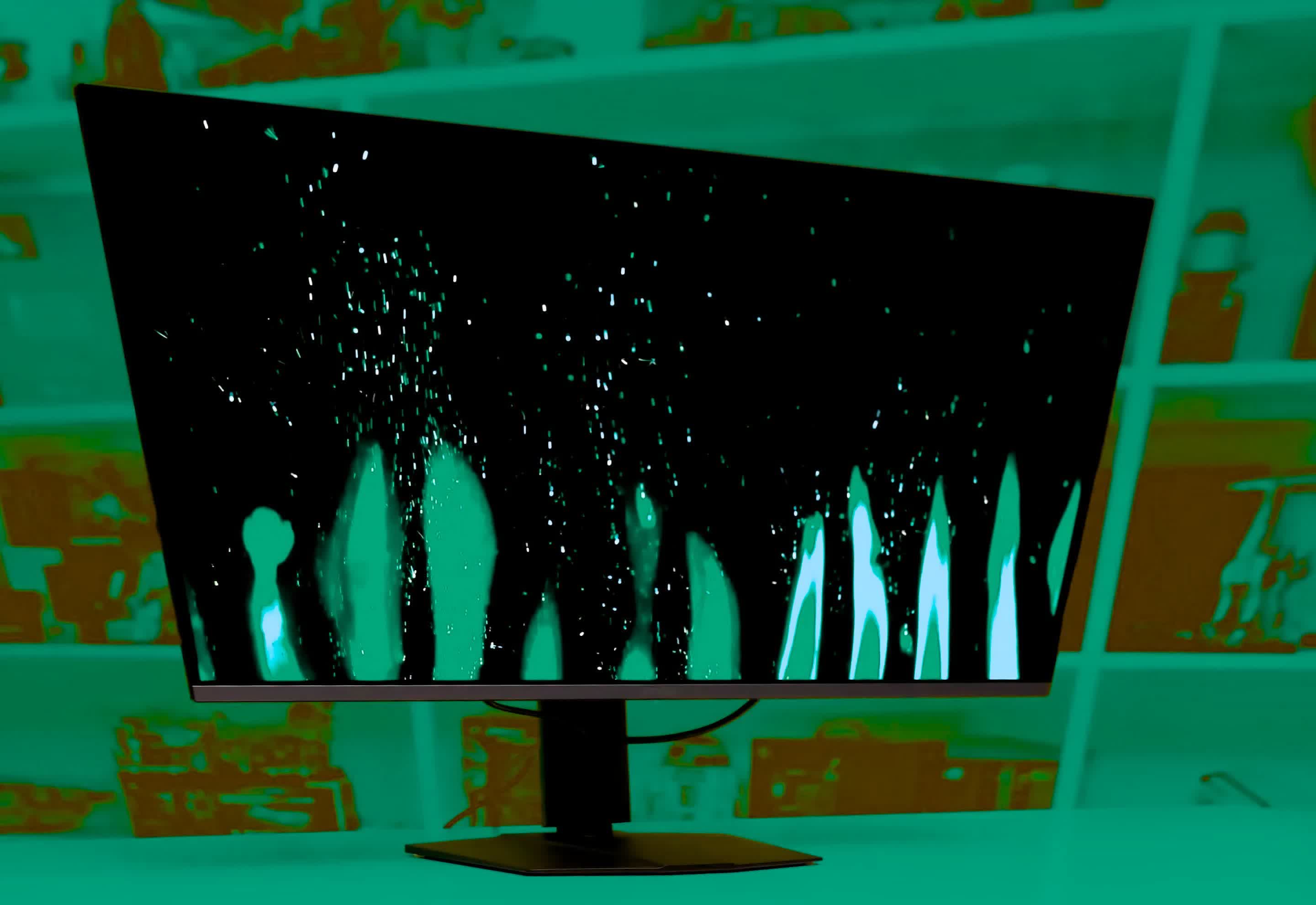
We've spent two and a half years burning in a 4K QD-OLED monitor, and it's time to see how it's holding up. Our MSI MPG 321URX has been used almost exclusively for productivity work, with static content such as web browsers, document editors, spreadsheets, and creative apps like Photoshop and Premiere. We don't recommend using an OLED this way. These displays are best suited to content consumption, but someone has to test it for science.
The test began when we replaced a 32-inch 4K IPS LCD used for work with a new 32-inch 4K QD-OLED and changed nothing else about the setup. There is no dark mode, no minimized taskbar, and no quick screensaver. It's an extremely demanding use case, but it reflects how the workstation has actually been used for years. The panel now has roughly 8,000 hours of usage, averaging 8 to 10 hours of static content daily at about 200 nits, and it has completed 865 compensation cycles.
The recommended interval is one cycle every four hours. Because the seven-minute pause is disruptive, the monitor runs its cycles only when asleep at the end of the day. That means only about half the recommended cycles have been completed, which adds further stress to the test.
The main artifact is a vertical line down the center of the screen, which marks the border between side-by-side application windows. Technically this is inverse burn-in: the brighter windows on either side have degraded the panel, while the line itself has stayed darker and is now clearly visible. The effect is most noticeable on uniform dark gray content, such as the backgrounds of some productivity applications.
Source: Hacker News · Summarized by HeadlinesBriefing