
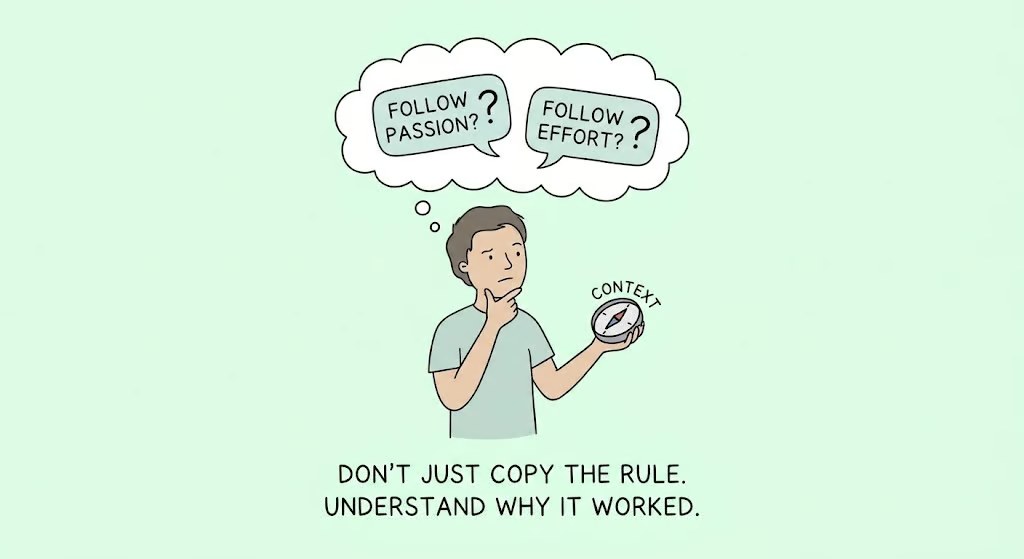
Steve Jobs told Stanford graduates to love their work and keep searching until they found their passion. Mark Cuban argues the opposite: follow your effort, because you will come to love whatever you get good at. Who is right? The author's answer is that both are right, but about themselves. Jobs was obsessive and only succeeded at things he cared deeply about, so his rule fit his wiring. Cuban tends to get hooked on anything he starts winning at, so effort-first worked for him. Many pieces of advice work this way. Two smart people can give opposite instructions, and both can make sense within their own experience.
The same pattern appears in the familiar contradiction between "say yes to everything" and "say no to almost everything." If your career has stalled or you are early on, saying yes more is likely excellent advice. If you already juggle ten commitments and cannot give any of them enough attention, the opposite is probably better. Engineers see this constantly, with one team praising microservices and another returning to a monolith, each right for its own size and problems. The author suggests asking what problem the advice solved, what was true about that situation, and whether any of it applies to you.
The author also recommends the boring answer when stuck. Weight loss offers a clear example: debates over keto, fasting and carbs often distract from the simple fact that eating less works. Ozempic, a major breakthrough, operates largely by reducing appetite, which the author finds amusing. Simple, obvious answers rarely sell, yet they often prove most useful.
Finally, when bombarded with advice, the author asks whether they can simply test it. Rather than accepting or dismissing claims that content creation boosts careers, the author ran a small experiment by posting consistently on LinkedIn and measuring the results. Running your own experiment yields an answer that fits your situation.
Source: Hacker News · Summarized by HeadlinesBriefing