
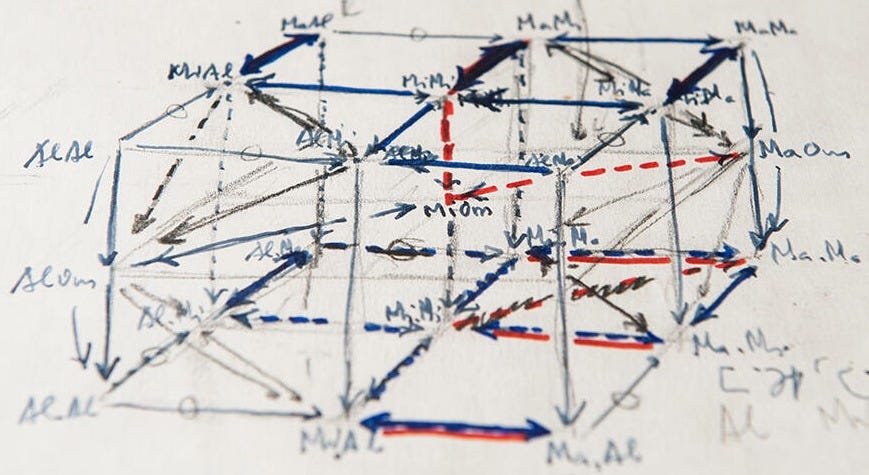
A mathematician who left academia for a machine-learning startup reflects on the gap between how mathematics gets credited and how it actually works. David recounts abandoning his "best theorem" — a cellular decomposition result he never formally published — because claiming it killed others' incentive to write it up. The real contribution, he argues, was the conceptual framework that made the theorem obvious.
This mirrors a deeper structural problem: academia rewards theorem-proving priority while undervaluing definitions, exposition, and the "secret math" of intuition. Hardy famously dismissed exposition as "work for second-rate minds." Thurston, a Fields medalist, dissented — but only after winning the field's highest honor. David's own career illustrates the tension: his cited preprint on Garside categories introduced definitions that later filled a 700-page book, yet the theorem itself went unpublished.
Now AI threatens to automate the "official math" of formal derivation while the human work of conceptual framing remains opaque. David, author of *Mathematica: a Secret World of Intuition and Curiosity*, sees an existential threat: if the public equates mathematics with theorem generation, the discipline's intellectual core — the hard-won definitions and mental models — could be devalued before AI ever replicates it.
His unpublished theorem sits on arXiv, cited but unformalized. The K(π,1) conjecture proof that elevated his status relied on Definition 9.3 — the very language he sacrificed the broader theory to complete. "The David who solved the conjecture is a social parasite of the much better mathematician," he writes. The system rewards the parasite.
Source: Hacker News · Summarized by HeadlinesBriefing