
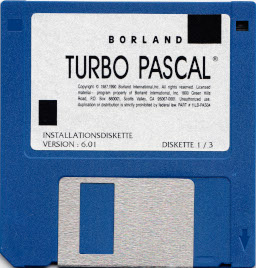
Borland's Turbo Pascal was one of the most successful programming tools of all time. It introduced development techniques such as integrated source-level debugging that we take for granted today but were radical at the time. TP 7, also known as Turbo Pascal for Windows 1.5, was the pinnacle of the Turbo Pascal line, and its end.
The name 'Turbo' was associated with what were regarded as hobbyist products, while Borland Pascal was a different, much more expensive product. But Turbo Pascal was enough for some quite substantial applications and was very affordable. It was also 'book licensed,' a new concept in the software industry.
You could buy one copy of TP, and any number of people could use it but only one at a time. Even when distributed on floppy disks, there was no copy protection. (Turbo) Pascal eventually gave way to Delphi, which despite its technical merits never had the same impact. Kevin Boone used TP 7 to write medical imaging software in the 90s to run under Windows 3.1, a great operating system in its day.
Like previous releases, Windows 3.1 was still an extension to MS-DOS with clever tricks to allow it to multitask and address more memory. It had a simple, consistent user interface model for both user and programmer. It had none of the wasteful and irritating anti-features that make modern Windows depressing to use.
Boone learned Pascal specifically to use TP 7; he was essentially a C programmer, but programming for Windows in C was a horrible job. TP 5 introduced basic object-oriented concepts to Pascal, which proved essential. The Windows-specific features were provided by the Object Windows Library, a thick wrapper around the basic Windows C API.
Borland introduced an object-oriented programming library for Microsoft Windows before Microsoft did, and Borland's was better. OWL made it easy to create nice-looking user interfaces with a bit of eye candy. The familiar 'green tick button' was an OWL enhancement, which became an irritating cliche.
It was much easier to program for Windows using Turbo Pascal 7 than with anything else. TP 7 also had fully-graphical tools for designing user interface elements like menus and icons. Laying out a menu using a definition file with an obscure format was never agreeable.
Microsoft produced graphical tools, but Turbo Pascal combined them into a seamless IDE. All one had to do to build and run programs was hit the F7 key. Boone could set breakpoints for the debugger by clicking a line of code.
As Boone said, it was revolutionary for early Windows programming. But what really made TP 7 special was its CP/M heritage. Turbo Pascal came to Windows by way of CP/M and MS-DOS, meaning it had a compiler core designed to run with tight memory and a comparatively slow CPU.
Source: Hacker News · Summarized by HeadlinesBriefing