
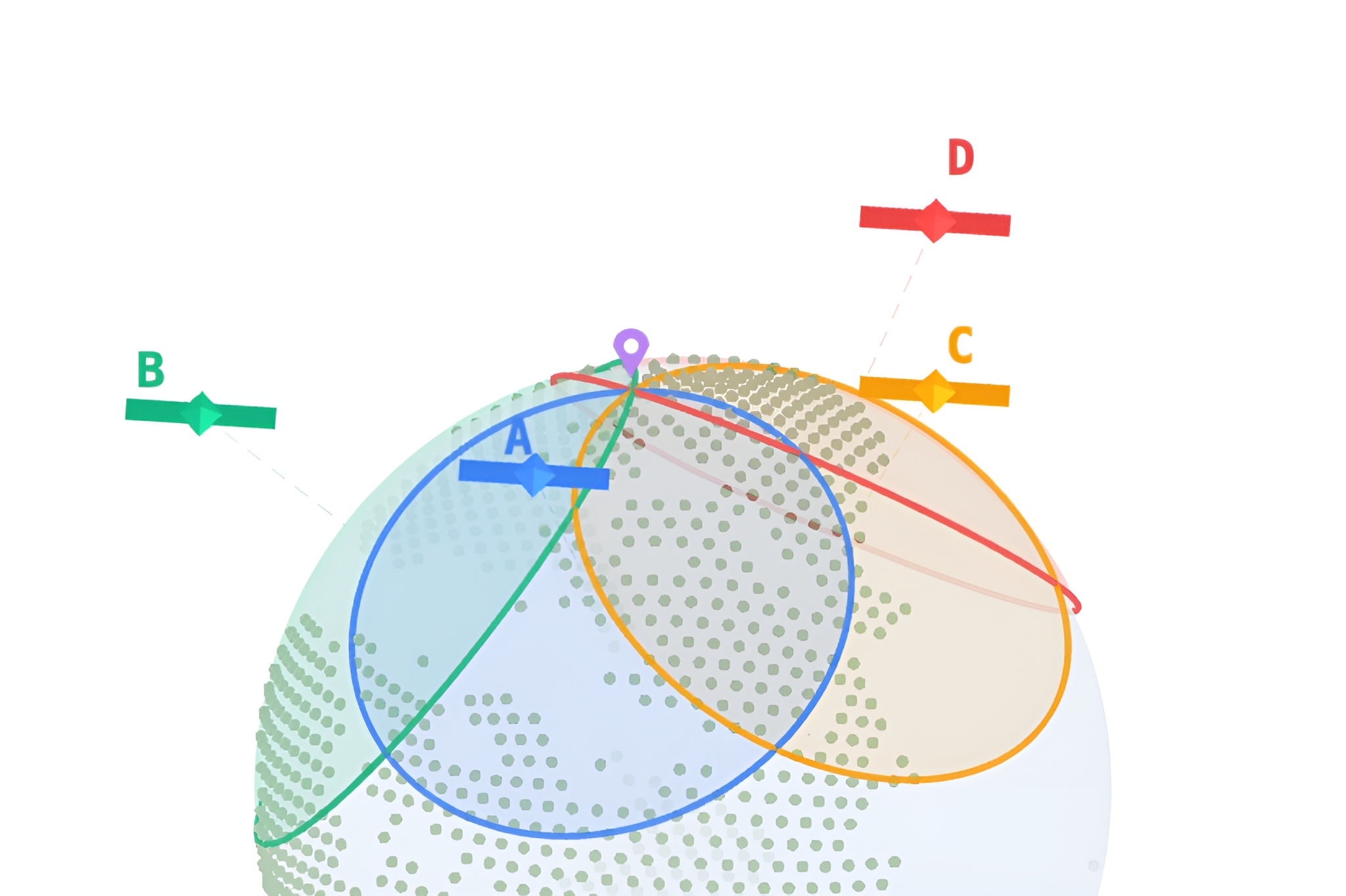
GPS translates time into distance. A satellite emits a signal at light speed; the phone records how long it takes. 1 ns of travel equals 0.3 meters, so the phone multiplies the measured time by the speed of light to get a raw distance. That distance is the first piece of a three‑dimensional puzzle for location fix today everywhere where.
One satellite gives a ring of possible positions; a second cuts the ring into two points, and a third selects the correct one. A fourth satellite resolves the receiver’s own atomic clock error, because the phone’s quartz oscillator drifts by thousands of nanoseconds. With four precise measurements the system converges to a single, accurate point in time for navigation anywhere.
Even after clock correction, Einstein’s theories still bite. Satellites orbit at about 3 km/s, losing time by ~4 µs per day, while weaker gravity makes them gain ~10 µs. The net gain of ~6 µs would shift a position by ~10 km each day without adjustment. Engineers pre‑tune clocks so that, once in orbit, the rates match ground clocks for precision in every navigation system.
Source: Hacker News · Summarized by HeadlinesBriefing