
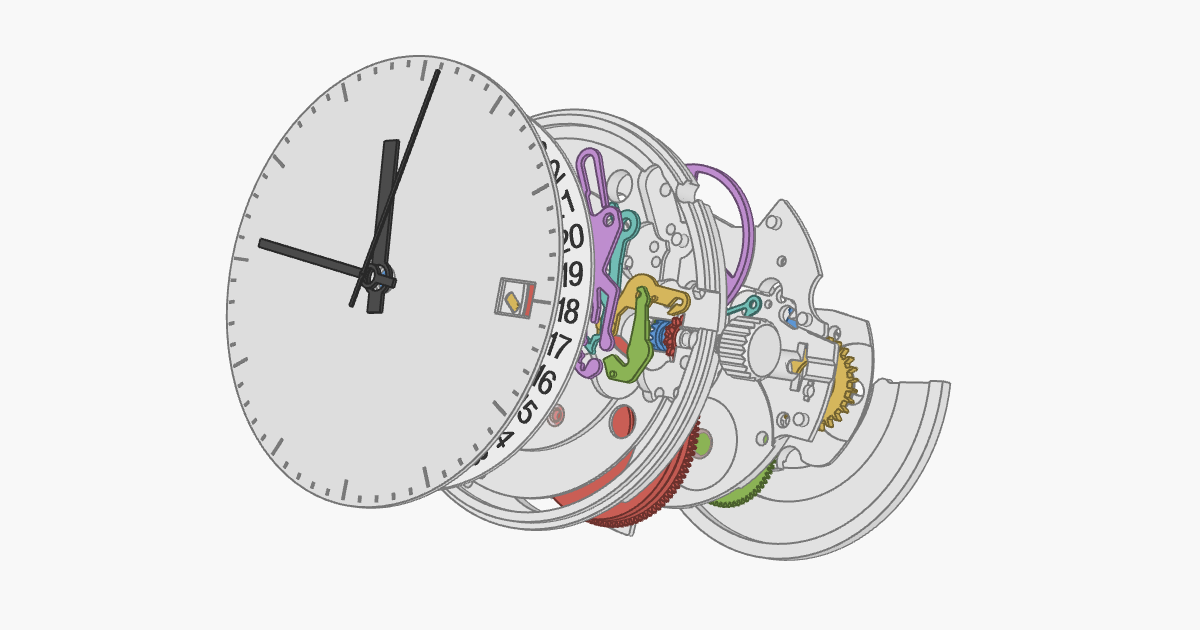
Mechanical watches seem archaic compared to smart devices, yet they represent remarkable engineering using only springs, gears, and pure mechanics. Writer Bartosz Ciechanowski breaks down the inner workings through interactive demonstrations that let readers manipulate components in real-time.
The core power source is the mainspring - a spiral torsion spring that stores energy when wound. Unlike typical coil springs, this design unwinds while maintaining rotational force. The spring sits inside a barrel casing that contains its expansion while the arbor mechanism allows controlled winding through the outer gear teeth.
Ciechanowski explains why directly attaching hands to the barrel fails spectacularly - the spring releases energy too quickly, spinning hands wildly before stopping. A watch needs roughly 40 hours of runtime, requiring the minute hand to complete 40 rotations while the second hand spins nearly 2,400 times.
The solution lies in gear ratios that transform slow barrel rotations into rapid hand movements. Each gear tooth engagement transfers motion between differently-sized wheels, creating the precise timing mechanics that make mechanical watches practical. The interactive models demonstrate these mechanical principles clearly.
Source: Hacker News · Summarized by HeadlinesBriefing