
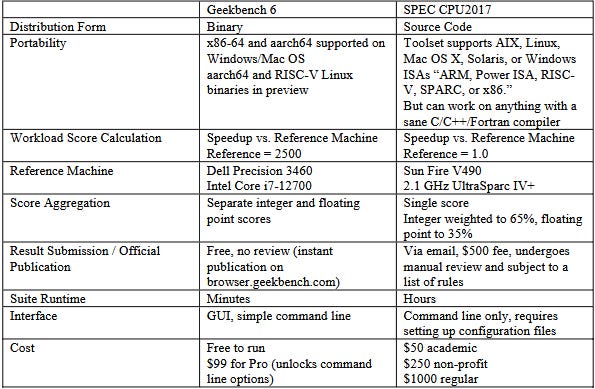
A detailed technical evaluation of Geekbench 6 reveals how the consumer-focused benchmark stresses modern CPUs differently than the industry-standard SPEC CPU2017 suite. Using Intel's Software Development Emulator to examine instruction-level behavior, the analysis shows that AVX-512 plays a prominent role in workloads like Background Blur, Object Detection, and Structure from Motion when targeting Intel's Granite Rapids architecture. AMX (Advanced Matrix Extensions) appears in Object Detection and Photo Library, accounting for a small fraction of executed instructions but delivering outsized performance gains—comparisons between Ice Lake X and Granite Rapids targets show AMX dramatically reduces AVX2 and AVX-512 instruction counts.
Instructions per cycle analysis reveals Geekbench 6's IPC distribution skews toward the medium to medium-high range, with many workloads averaging well beyond 2 IPC on high-performance cores like Intel's Lion Cove and AMD's Zen 5. Skymont often approaches these cores in IPC terms but shows vulnerability in "glass jaw" cases. In contrast, SPEC CPU2017 displays a wider IPC distribution with more difficult low-IPC workloads, particularly in the integer suite where 505.mcf and 520.omnetpp pose challenges even for sophisticated cores. Geekbench 6's tighter IPC distribution places it closer to SPEC's floating point suite than its integer tests.
Branch prediction proves to be a significant bottleneck, with Navigation standing out as particularly challenging—its high mispredicts per kilo-instruction figure makes it likely the primary factor behind low IPC on that workload. Even advanced predictors provide limited relief, meaning newer cores see minimal IPC gains over decade-old designs. Asset Compression presents an odd asymmetry where Skymont's predictor stumbles (4.33 MPKI) while older architectures like Puredriver manage 2.76 MPKI. On the cache side, only Clang overflows Lion Cove's 5.2k entry op cache, and several Geekbench 6 workloads execute tiny loops fitting comfortably in the 192-entry loop buffer.