
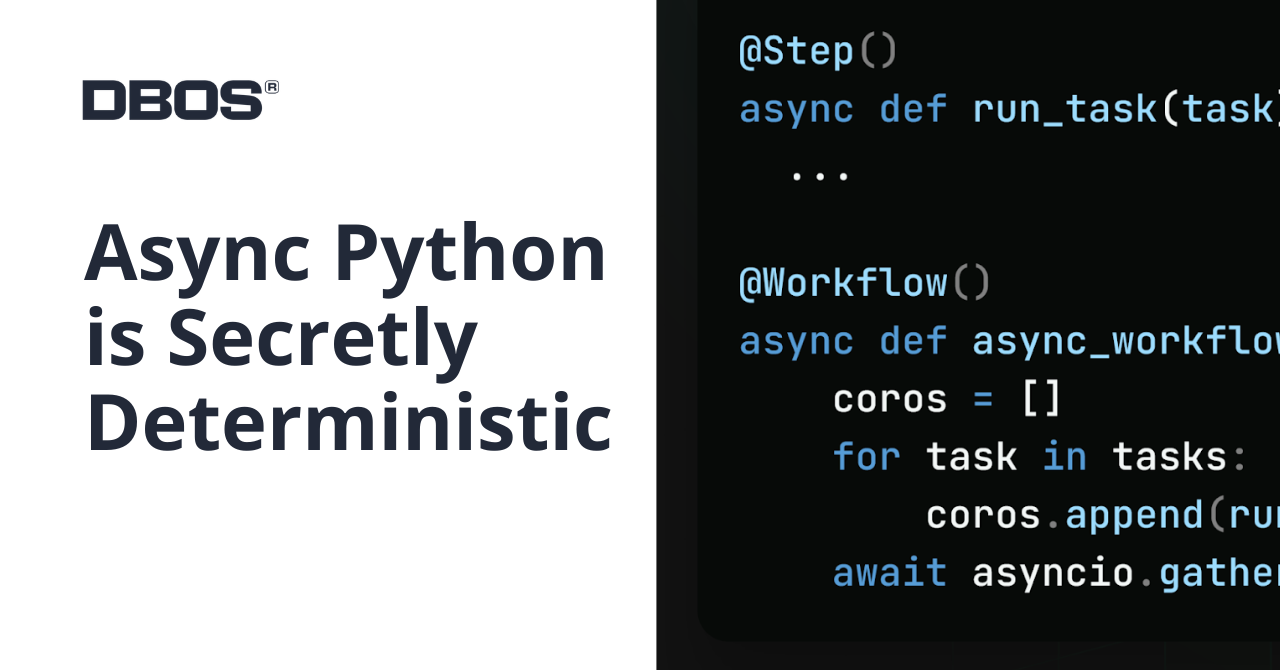
DBOS added async support to its durable execution library, confronting a core issue: workflows must stay deterministic to allow replay‑based recovery. Concurrency in async Python, especially with asyncio.gather, blurs step order because tasks run simultaneously and finish unpredictably. The library’s goal is to keep performance while ensuring a fixed execution sequence.
Under the hood, async Python relies on a single‑threaded event loop that schedules coroutines. When a coroutine is wrapped in a task via asyncio.gather, the loop enqueues it in FIFO order. The loop then runs each task until it yields, resuming later when awaited I/O completes. This deterministic queuing underpins reproducible workflow steps.
DBOS solves the ordering problem by injecting a step counter in the @Step() decorator. Before any await, the decorator assigns a sequential step ID from the workflow context. Because tasks are queued deterministically, the first coroutine gets step 1, the second step 2, and so on, guaranteeing a fixed order even when execution interleaves.
The result is a library that lets developers write concurrent Python workflows without sacrificing reliability. By understanding the event loop’s FIFO nature and embedding deterministic IDs, DBOS turns what appears chaotic into a predictable, replayable sequence. This approach simplifies debugging and recovery for production‑grade durable systems.
Source: Hacker News · Summarized by HeadlinesBriefing