
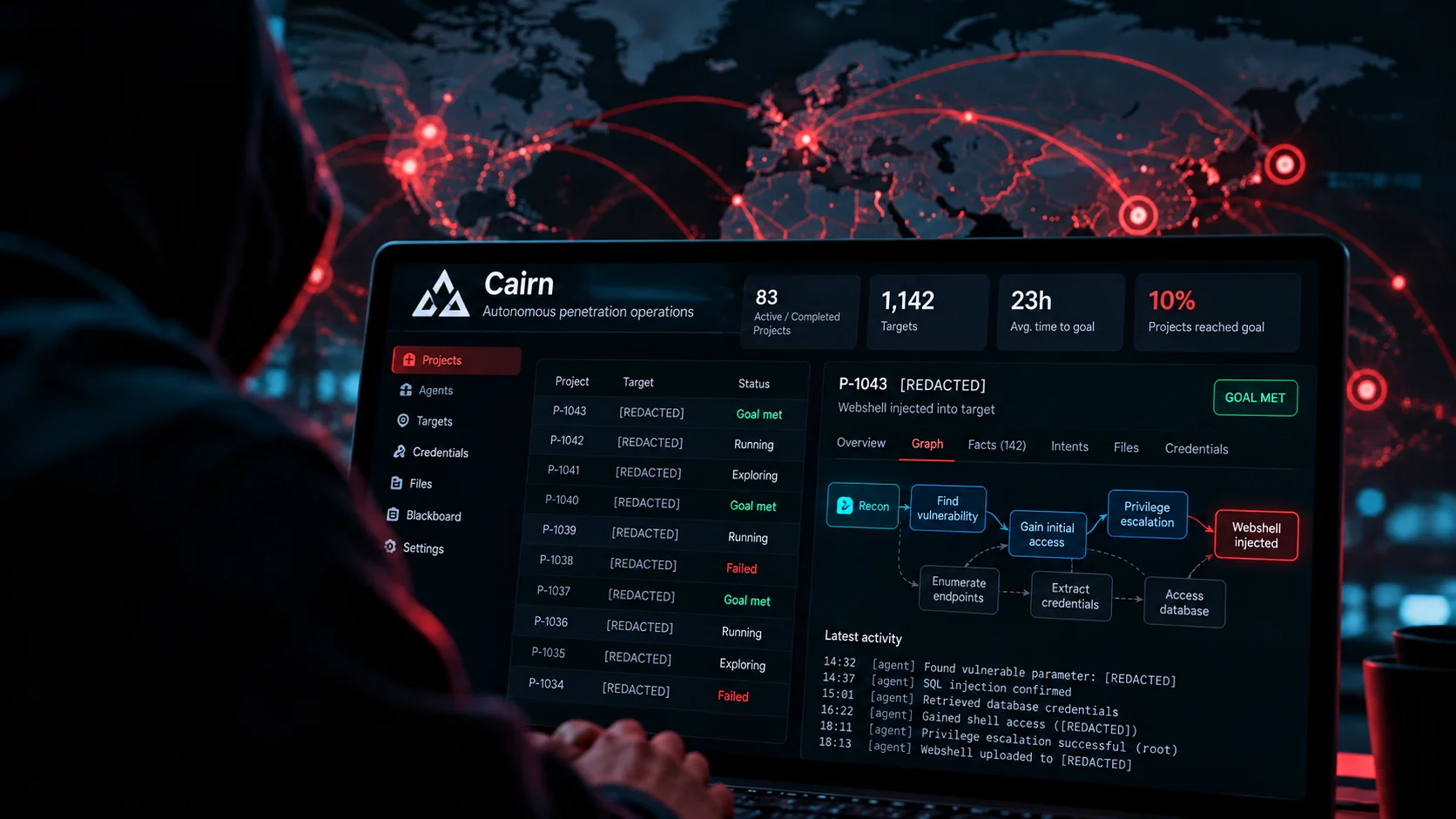
An investigation by Nor Forge into publicly exposed AI-driven penetration-testing control panels has uncovered how they are extensively used in malicious cyber operations. One of these is Cairn, an AI-powered hacking system. Given a target and an objective, it can coordinate AI agents to investigate the target, search for security weaknesses, and attempt to break in. More than 20 exposed Cairn panels were identified as likely associated with malicious activity, providing an unusually detailed view of how threat actors select targets, direct autonomous agents, exploit vulnerabilities, and establish persistent access to compromised systems.
The investigation traces back to a September 2026 report by Gambit Security on a criminal intrusion campaign targeting online marketplaces. Researchers recovered an attacker's staging server and found the use of AI harnesses such as Hermes, Strix, and Cairn. Such tools frequently have web-based interfaces that are left unsecured on the open web. Quick searches using Shodan and Censys revealed hosts running what appear to be AI harnesses, most of which require authorization. Continued scans revealed new Cairn panels coming online in short order, and targeting information and instructions showed many of them to belong to the same threat actors.
The exposed panels reveal sensitive information about targets, including the weaknesses uncovered, account secrets, API keys, and whether systems have been compromised. Because of this, the researchers say they are redacting extracted data and withholding panel addresses until the panels can be taken down. One exposed operator task contained secrets, and even root access to the attacker's data drop was exposed.
Cairn is more generic than a pure penetration-testing tool. It is a state-based problem-solving engine that moves step by step from an origin toward a defined goal. Each task is a project, and agents post discovered facts to a shared blackboard, where human operators can also add hints. Not all paths succeed, but one attack directed at a major US online retailer ended with a webshell injected into the site. Several exposed panels also appeared to belong to legitimate demos or red team operations, which the researchers say they will not identify.
Source: Hacker News · Summarized by HeadlinesBriefing