
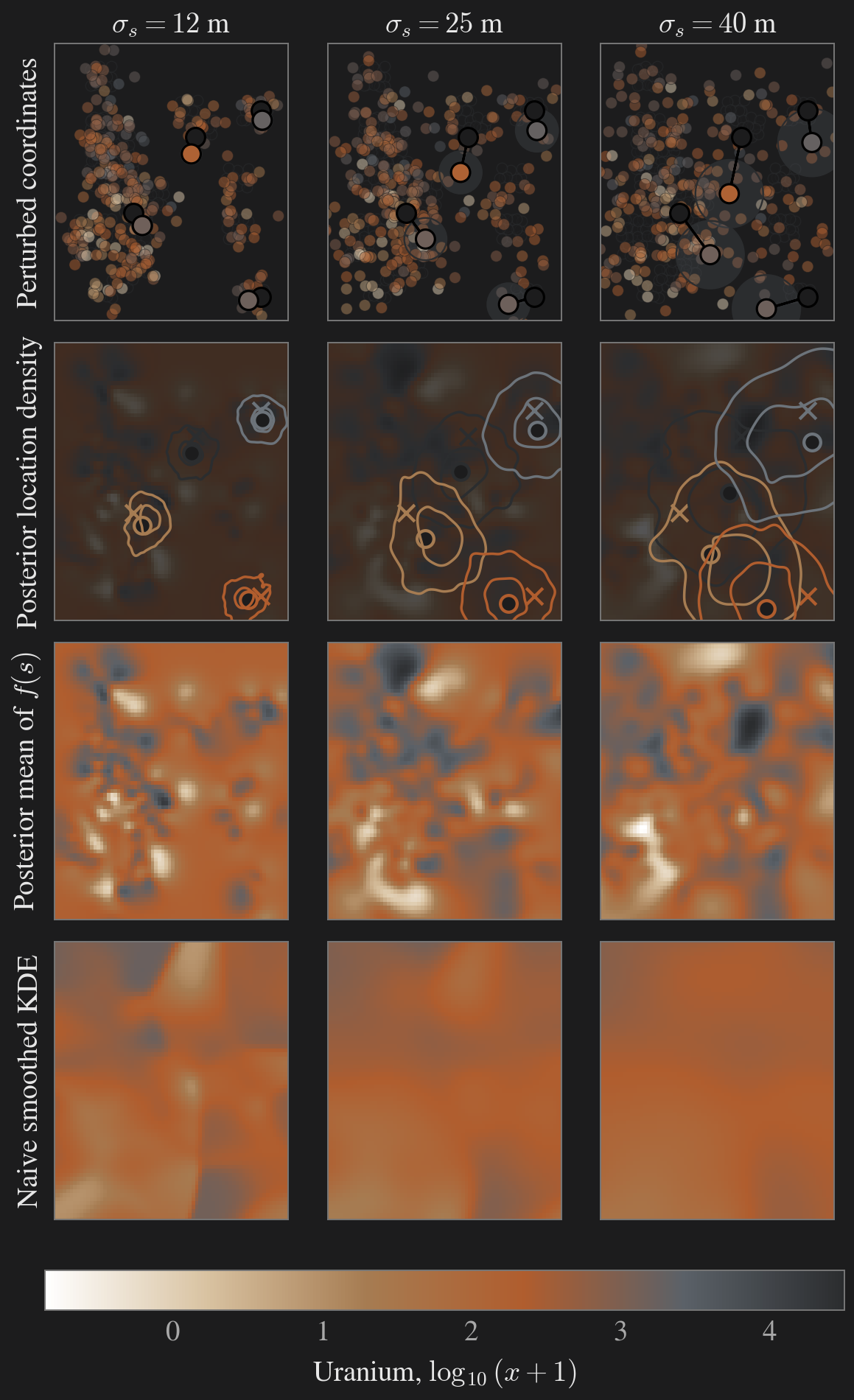
Mining crews drill holes to sample ore concentration, then face a sparse map of underground data. In such cases, Gaussian process models usually fill gaps, but real surveys suffer from noisy coordinates. The study re‑engineers the GP to treat each point’s true location as a latent variable, adding a normal error term in the analysis.
Using Walker Lake uranium and vanadium measurements, the authors perturb recorded coordinates with multipliers of 12, 25, and 40 to simulate increasing error. They fit the model with pymc’s pm.gp.Marginal, integrating over the latent GP values. Convergence diagnostics reveal rising divergences and R̂ values as noise escalates in the posterior sampling procedure and model.
Each latent coordinate is modeled as the observed point plus a zero‑mean normal offset with known σₛ. Priors on μ, σ, ℓ, and σ₀ follow HalfNormal distributions, while the mean function stays constant. The model’s flexibility demonstrates how Bayesian priors can adapt a GP to imperfect spatial inputs, a common issue in geophysics and robotics.
The study highlights that ignoring location uncertainty can bias predictions, stressing the need for GP formulations in a field that relies on spatial data with error. In practice, this means that engineers extracting maps or autonomous robots navigating uneven terrain must account for positional noise; otherwise, predictive uncertainty underestimates risk and can lead to missteps.
Source: Hacker News · Summarized by HeadlinesBriefing