
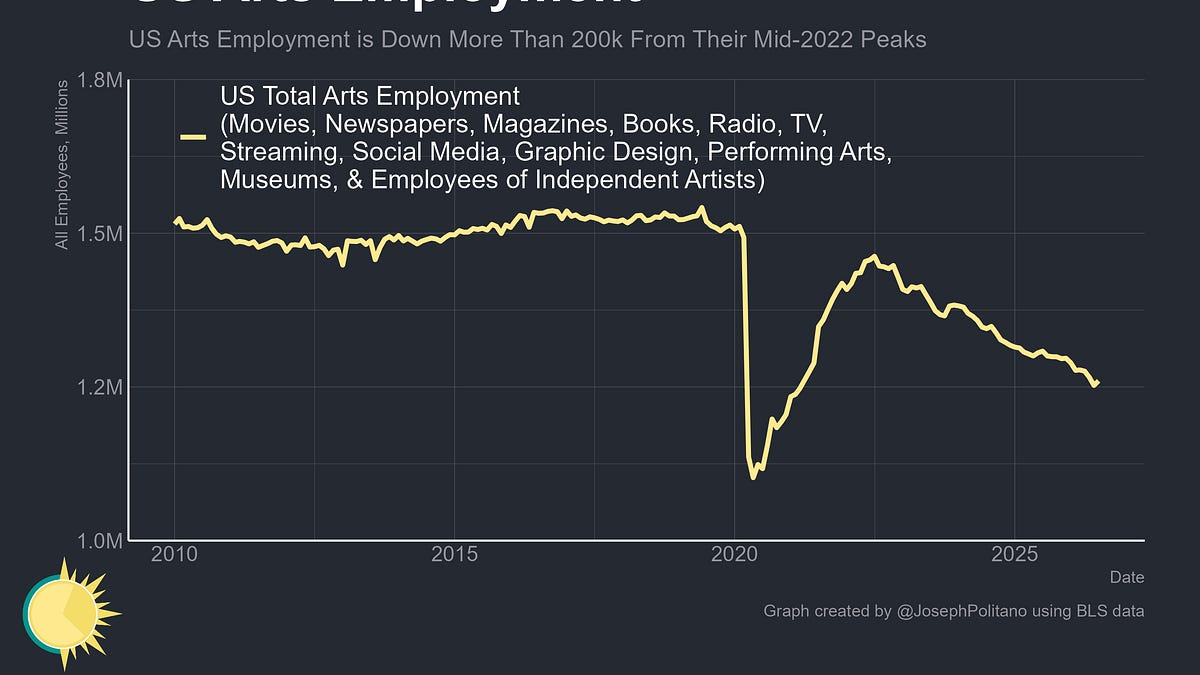
America has lost over 200,000 jobs in media, film and the arts over the last four years, with roughly 50,000 lost in the last year. This represents one of the worst stretches for media employment in modern US history, comparable only to the 2001 and 2008 recessions. Yet there is no generalized recession today; instead, this job loss coincides with the rise of AI systems capable of composing novels, generating photorealistic images and soundalike music at extremely low costs.
Is this the fall of the Creative Class? Proving exact AI-driven job loss is difficult as media firms are coy about AI use to protect against public backlash and preserve copyright legal bases. The effects of AI are hard to disentangle from other factors affecting arts businesses, such as Hollywood consolidation, offshoring content production, and the displacement of traditional media by social media creators. However, the clearest evidence of AI's influence is that all subsectors of the digital arts industry are losing jobs, while in-person entertainment is still growing at a healthy pace.
Digital job losses are a continuation of prior trends, like technological change grinding away newspaper and magazine jobs for decades. Yet for sectors like live broadcasting, streaming, or graphic design, recent experience is an unusual downturn compared to the tranquility of years prior. The worst-hit sector is movie & sound recording, bleeding jobs at an unprecedented pace over the last three years.
Hollywood has never seen a stretch as bad as the last four years, with the industry losing more than 100,000 jobs, nearly one-third of the sector's total. At depths this summer, total employment was lower than at any point since the 2008 recession and approaching the lowest point in 30 years.
Source: Hacker News · Summarized by HeadlinesBriefing