
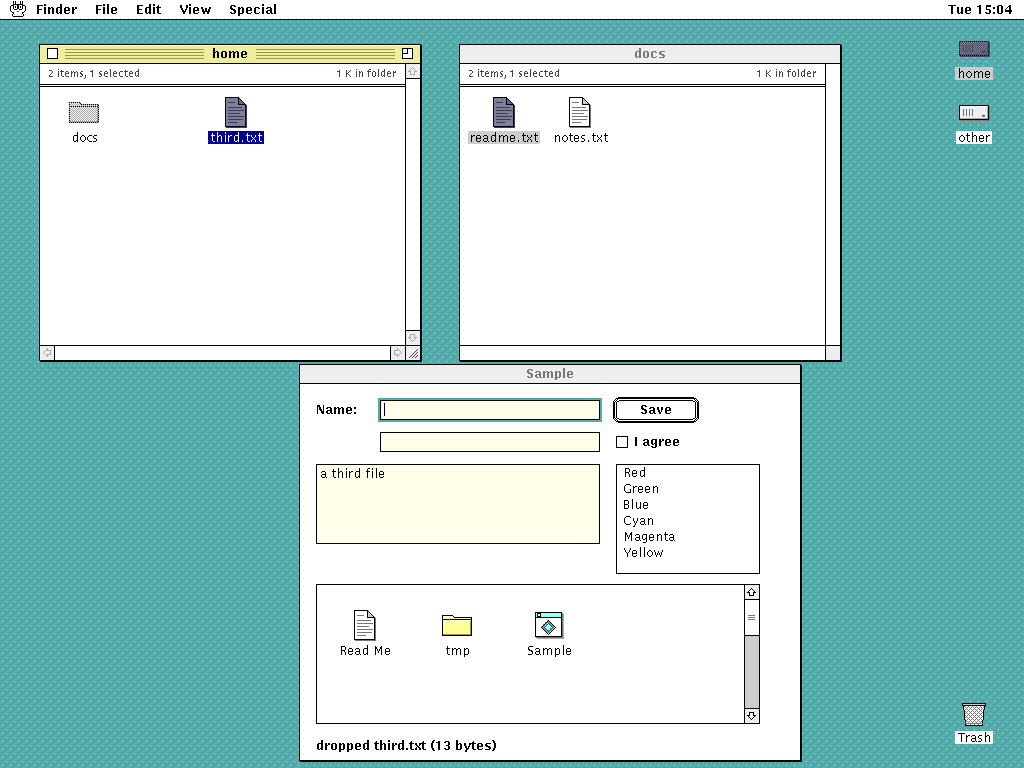
9/UX brings the classic Macintosh spatial desktop to 9front, the Plan 9 operating system. This live web demo runs a rio fork in 9/UX mode, rendering a spatial desktop with global menu bars, consistent controls, and iconic resource-driven presentation. The interface leverages rio and libdraw for rendering, with 9P exposing application UI state as files. Namespaces define the environment, the plumber opens documents, and ndb stores metadata. Key components include a rio fork for the desktop layer, a Toolbox via libux for controls, and resfs for resources. The design preserves the Macintosh direct-manipulation model while making all objects visible as Plan 9 files. Native 9front programs remain first-class, and existing rio programs like acme and sam function unchanged. The visual style uses a sixteen-color palette with butter title bars, acme cream and olive, and rio greygreen. The source code is hosted on GitHub under the MIT license, developed on h9 without VMs. This is a real end-to-end drag-and-drop test running headless on h9, with UI state driven by 9P files.
The developers aim to keep the Macintosh experience while integrating it natively into the Plan 9 ecosystem. The demo showcases windows, menus, dialogs, and file management through the plumber. It demonstrates how 9/UX acts as a layer over standard rio, offering a spatial folder structure and remembered layouts. The project highlights the flexibility of Plan 9's file-driven UI philosophy applied to a familiar desktop metaphor.
Source: Hacker News · Summarized by HeadlinesBriefing