
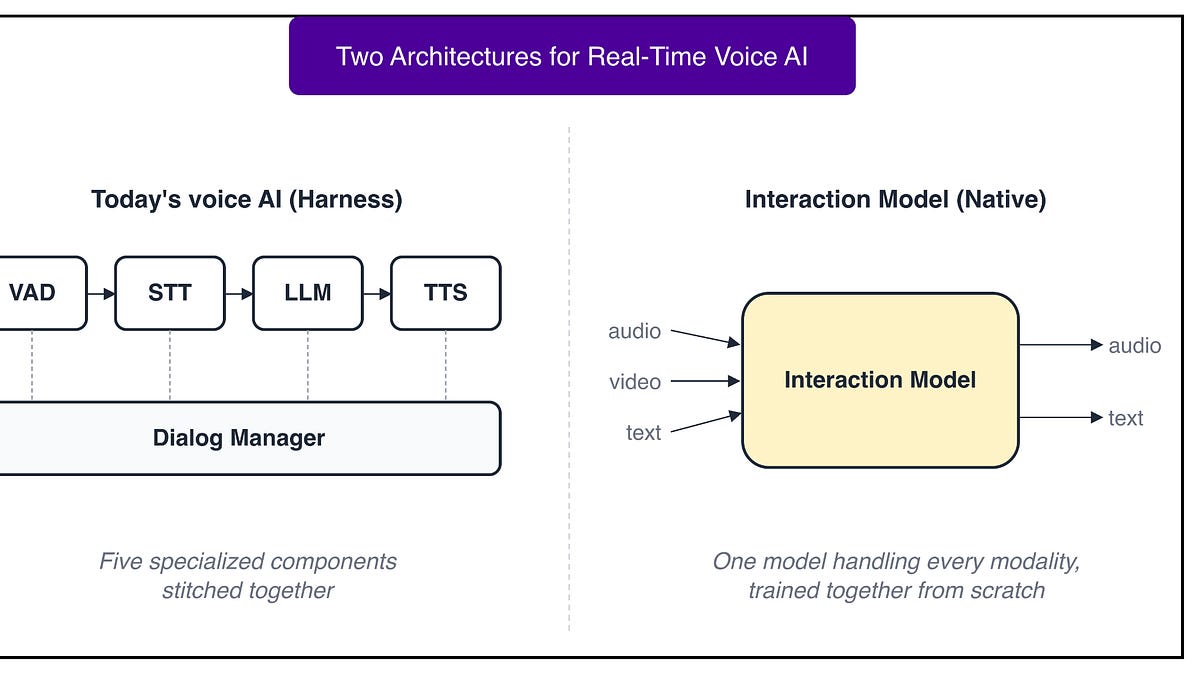
Most current AI systems rely on a fragmented stack of helper tools to simulate real-time conversation. These systems use separate models for speech-to-text and voice activity detection, creating a bottleneck that limits true collaboration. Because these components operate independently, the central language model cannot perceive nuances like tone or mid-sentence interruptions, forcing users to communicate in rigid, turn-based patterns.
To solve this, Thinking Machines is developing an architecture that integrates interactivity directly into the model. Their first iteration, TML-Interaction-Small, uses a mixture-of-experts approach with 276 billion parameters. Unlike traditional multimodal models that layer audio onto text, this system treats continuous audio and video as its primary foundation to handle concurrent input and output streams.
This shift moves away from hand-crafted heuristics toward a unified learning approach. By bypassing heavy pretrained encoders and focusing on time-aligned micro-turns, the lab aims to enable proactive-interruption capabilities. This architecture treats human-AI interaction as a continuous stream rather than a series of discrete, disconnected prompts.
Source: ByteByteGo · Summarized by HeadlinesBriefing