
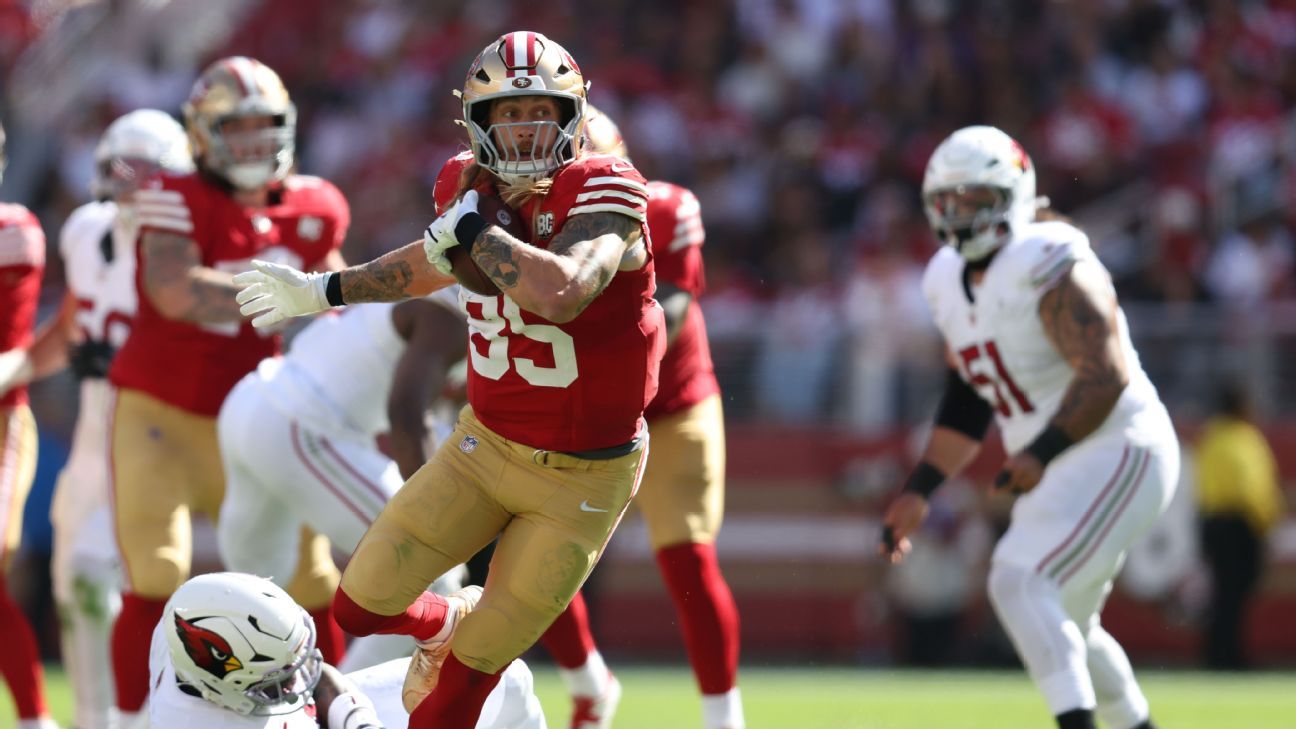
Despite tearing his Achilles in the playoffs, Kittle appears to be back to his normal self. Here's how he won the recovery process.
At 5:30 on a late March morning, eight weeks after surgery to repair his torn right Achilles, San Francisco 49ers tight end George Kittle was wide-awake. Kittle and a close group of friends had traveled to Bandon Dunes Golf Resort in Oregon for six rounds in four days. For 49ers fullback Kyle Juszczyk and others of the traveling party, it was a leisurely weekend on the links. For Kittle, it was an important step in his road back to the football field, a path he had defiantly proclaimed could have him ready for Week 1 in Melbourne, Australia.
"It's fun to be doubted," Kittle, 32, told ESPN last week. "I'm not a chip-on-my-shoulder guy whatsoever, but when you have all the people who are like, 'Oh, you're not doing this, you're not doing that.' I'm like, 'I am doing that and extra. You believe whatever you want, you can talk however you want to talk, but when you see me Week 1, you can kick rocks.'"
Kittle's discipline fueled an odds-defying, 243-day recovery from a torn Achilles suffered in a Jan. 11 NFC wild-card win over the Philadelphia Eagles. Through those eight months, he channeled his usual golden retriever energy into tedious daily rehab. The usual recovery can take anywhere from eight months to a year, and a June 2026 study done at Michigan State University and published in the Physician and Sportsmedicine Journal said only 27.1% of NFL players return to pre-injury performance levels. But so far this season, Kittle has reasserted himself as one of the league's best tight ends.