
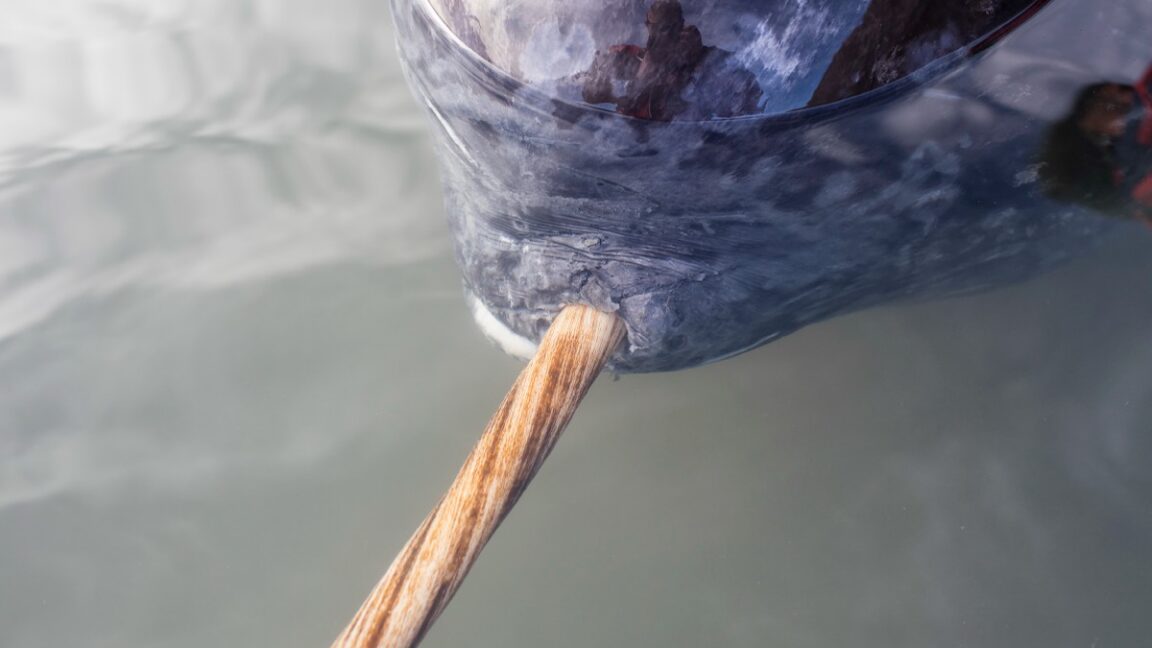
Scientists have long known that the narwhal’s narwhal tusk spirals left‑handedly and consists of dentine coated with cementum around a central pulp chamber. The dentine and cementum are built from collagen fibrils mineralized with hydroxyapatite nanoparticles. Researchers questioned whether the helical arrangement extends to the micro‑ and nanoscale, a question unanswered until now.
To map the structure across atomic, nano, and macroscales, the team used X‑ray computed tomography, scanning X‑ray diffraction, small‑angle X‑ray scattering, tensor tomography, and birefringence microscopy on two male specimens. Measurements were made at synchrotrons in Sweden, Switzerland, and France, complemented by standard morphology and three‑point bending tests. The scans revealed that collagen fibrils and nanoparticles align mainly along the tusk’s long axis, giving high anisotropy at every scale. The combined data showed that while the overall orientation is highly aligned, the minute off‑axis tilts accumulate to produce the macroscopic spiral.
Tiny angular deviations in that alignment generate the twisted form: the cementum creates a left‑handed helix while the dentine forms a right‑handed double‑helix. This arrangement gives the tusk exceptional stiffness and strength, allowing it to bend and twist without cracking and to grow straight, unlike an elephant’s tusk. Co‑author Henrik Birkedal noted that, because whales can live up to 80 years, the tusk records environmental changes, a line of work the group is now pursuing.
Source: Ars Technica · Summarized by HeadlinesBriefing