
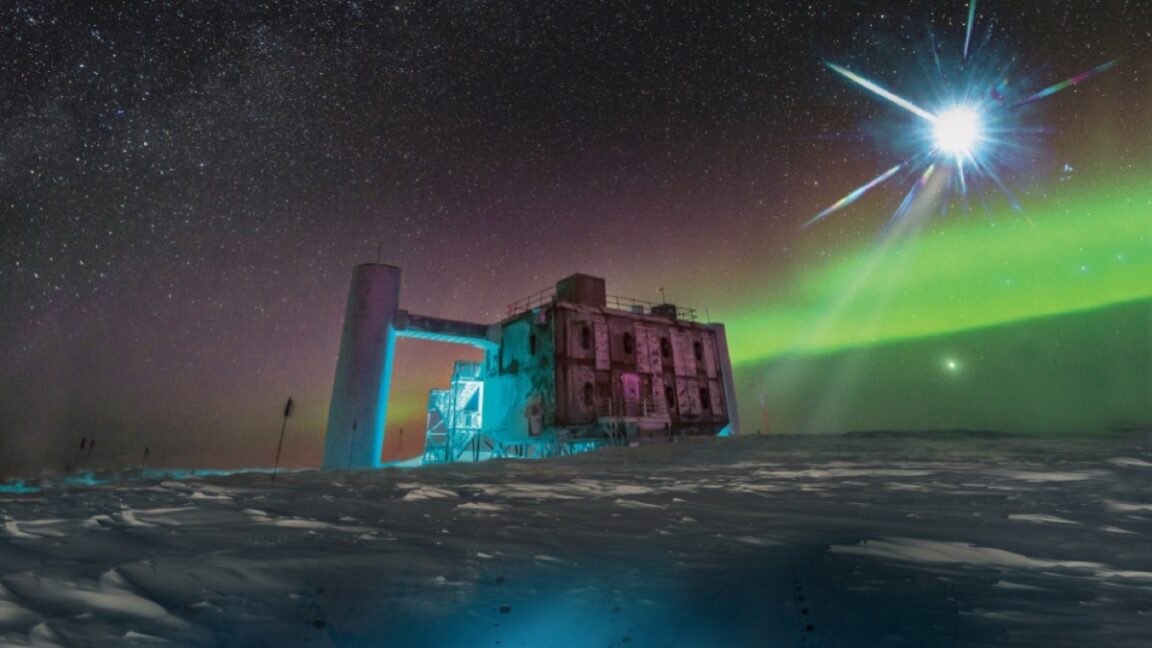
Francis Halzen, a physicist at the University of Wisconsin, Madison, has won the 2026 Nobel Prize in Physics “for decisive contributions to the Ice Cube Neutrino Observatory and the discovery of high-energy neutrinos of astrophysical origin.” Halzen spearheaded the development and construction of the Ice Cube Neutrino Observatory in Antarctica, enabling physicists to capture high-energy neutrinos created in the distant universe. “It was a great surprise, and I obviously didn’t expect it,” Halzen said during a news conference in Stockholm, Sweden, speaking by phone from Italy. While the Nobel was awarded to Halzen, he emphasized that his work was the result of a “large collaboration” with other researchers.
“This reflects on the really courageous people who joined me in this project when really no respectable conservative physicist would have joined me. But many talented people did, and that’s why I’m here,” he said. Particle physicist Danielle Norcini of Johns Hopkins University said, “He is the scientific visionary and driving force behind [Ice Cube]. It has transformed our understanding of the universe by detecting the first high-energy neutrinos from beyond our galaxy, opening an entirely new field of neutrino astronomy.”
As previously reported, neutrinos travel near the speed of light. They have no charge and very little mass, making them extremely difficult to detect. Isaac Asimov dubbed them “ghost particles.” Because they can escape unimpeded by collisions, they provide valuable clues to astronomers about distant systems, contributing to “multimessenger” astronomy. Neutrinos were first proposed by Wolfgang Pauli in 1930, and Clyde Cowan and Frederick Reines first observed them in 1956.
Source: Ars Technica · Summarized by HeadlinesBriefing