
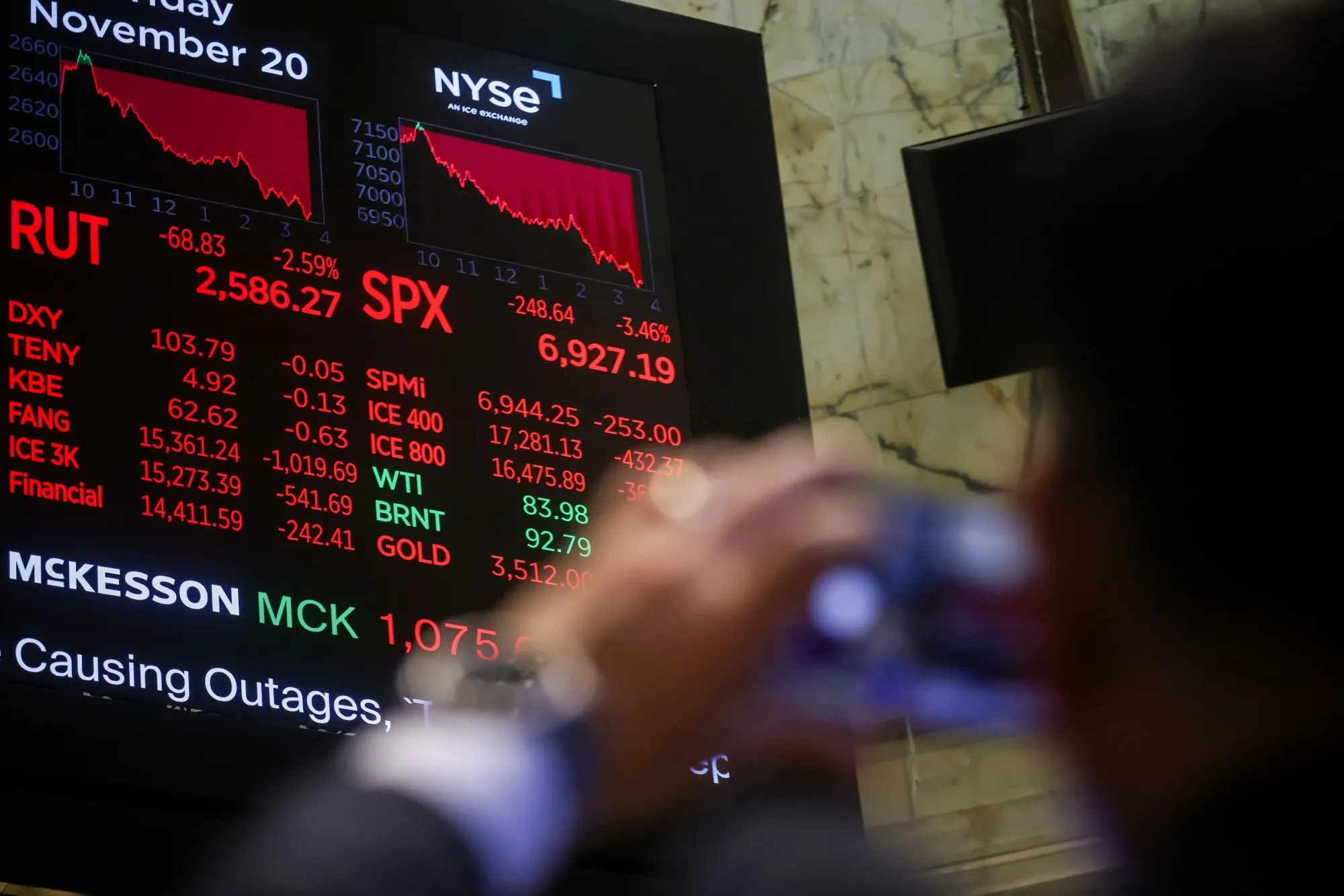
Wall Street’s unwind wiped more than $5 trillion from the S&P 500 last week, exposing how much the market relies on its biggest stocks and the AI investment boom. The benchmark dropped 8.6%, its ninth-largest weekly decline since 1990, leaving it 12% below its October peak. Nvidia Corp. led the retreat, falling 23% after a brief rally on strong earnings.
The equal-weighted S&P 500 lost 6.3%, showing the damage spread beyond tech. Megacap valuations are converging with the broader index at the fastest pace since the pandemic, while future profits remain unusually dependent on chipmakers and AI spending. Chipmakers account for 13% of the S&P 500 by weight but are expected to deliver nearly two-thirds of its net-income growth in 2027.
Five companies drive half of that growth, making the market highly vulnerable to any slowdown in AI investment. The Philadelphia Semiconductor Index has fallen 43% from its June peak, yet forward earnings estimates have climbed 35% to an all-time high — a divergence that historically precedes fundamental shifts. Since 1990, only 4 of 13 corrections became bear markets, each tied to major shocks.
With the S&P 500 now 11.6% below its peak, the key question is whether the AI unwind remains a repricing or signals a deeper downturn.
Source: Bloomberg Markets · Summarized by HeadlinesBriefing