
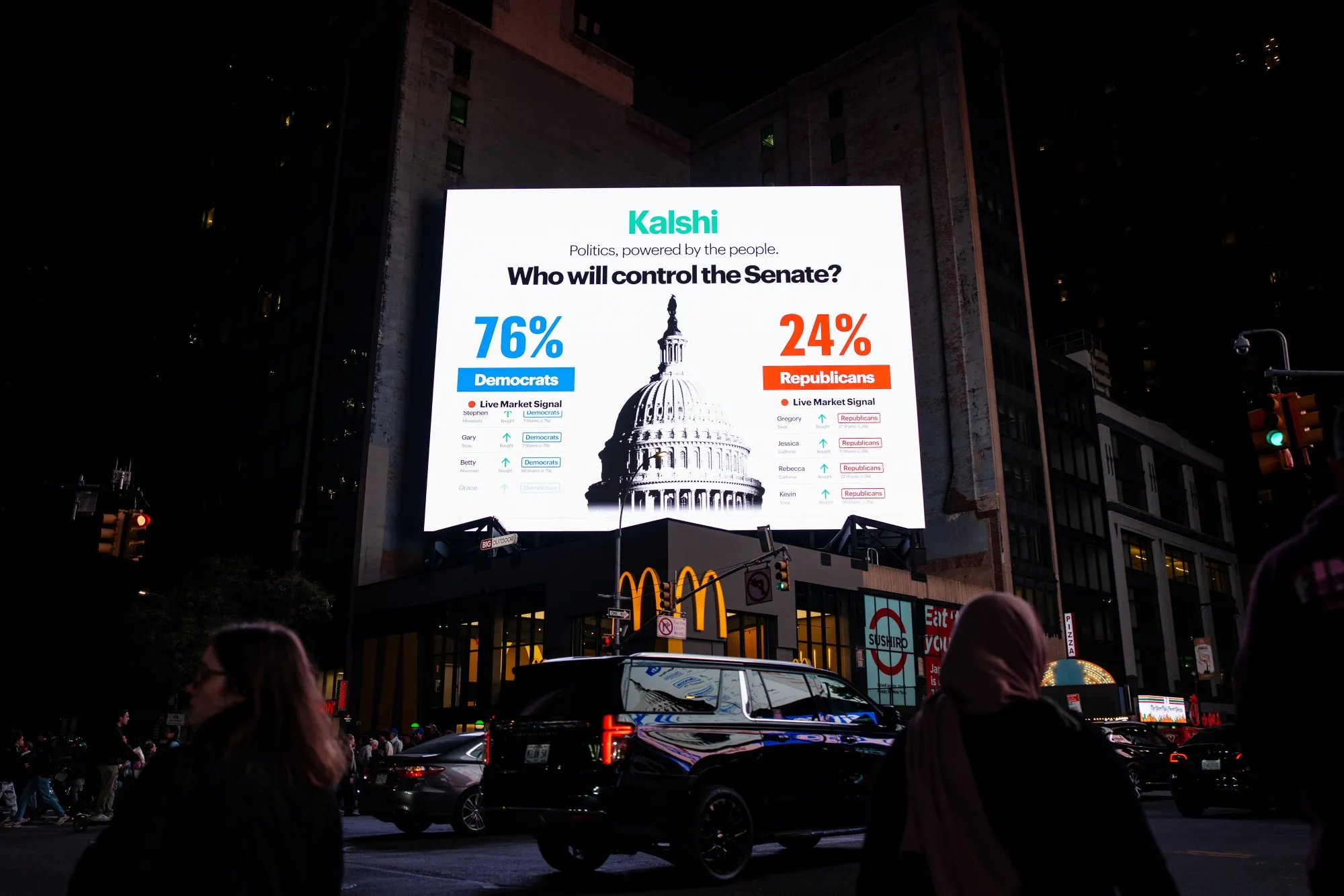
The US presidential election in 2024 was a big-bang moment for prediction markets. Two years later, their forecasts on the 2026 midterms are getting plenty of attention, but the underlying trading shows the platforms have struggled to expand beyond a few booming categories.
In the final week before Election Day, turnover on US election-related markets on Kalshi Inc., the biggest prediction market, was roughly the same as in the comparable period before the 2024 vote, a Bloomberg News analysis of trading data shows. On Polymarket, Kalshi's main rival, US election trading has shrunk significantly when activity on both its longstanding international exchange and its newer US exchange is combined. That lack of growth is notable given that overall volume on the platforms has multiplied more than 20 times since October 2024. Almost all of that expansion came from trading on sports and crypto prices, while smaller categories, including elections, have attracted relatively small and sometimes declining activity. Last month, politics accounted for just 1% of trading volume across Kalshi and Polymarket, down from two-thirds during the 2024 presidential election.
Limited interest in the midterms is a problem for prediction markets. Industry advocates often point to election markets and their forecasts as evidence the platforms offer socially useful information rather than just another venue for betting. Exchanges are under pressure to demonstrate that public value as dozens of states accuse them of trying to circumvent state gambling laws. "They need to prove to their investors that they have another business," said Koleman Strumpf, a professor of economics at Wake Forest University in Winston-Salem, North Carolina.
The weak volume also leaves many forecasts more vulnerable to manipulation. An analysis by the Anti-Corruption Data Collective found that almost all midterm-related markets on Polymarket and Kalshi have such low liquidity that it would take only a few thousand dollars to move their forecasts meaningfully. "A savvy, potentially malicious actor could go in and bet a small amount of money and skew the odds," said David Szakonyi, a co-founder of the collective and a political science professor at George Washington University.
Kalshi spokesperson Jack Such called the findings "baseless," arguing the actual cost of manipulation would be much higher and that its markets remain well-calibrated. Both companies say they have systems in place to monitor suspicious trading.
Source: Bloomberg Markets · Summarized by HeadlinesBriefing